
The signed trust amendment is sitting in somebody's inbox. The CPA thinks the attorney has it, the attorney thinks the family sent it, and the filing deadline is Friday. Once weeks like that stop feeling unusual, your family office is ready for its first administrative assistant, or at least for the support that role is meant to provide.
Most families hit that point after a liquidity event, or when trusts, LLCs, properties and advisors pile up faster than anyone can track them. Any single slip looks minor. A renewal lapses because nobody owned it, or an advisor requests the same document twice. Over a year, those slips add up to an office that has outgrown informal administration.
So if you're weighing whether to bring on a family office assistant, start with a sharper question: what kind of support does your office actually need? Family Office Administrative Support comes in three forms. You can hire in-house, bring in a structured outsourced system through professional family office services, or combine the two. Below, we walk through the signals that tell you it's time, what each path costs, and what to put in place before anyone starts.
TL;DR Quick Answers
Family Office Administrative Support
Family Office Administrative Support is the structured system that keeps a family's documents organized, advisors aligned and deadlines met, with one team accountable for follow-through. It works alongside the family's CPA, attorney and insurance advisor.
What it includes: Document management, a secure electronic vault with defined permissions, provider coordination and tracking of recurring obligations such as filings and renewals.
Who needs it: Families with several entities, trusts or residences, documents spread across advisors, or a business sale, estate update or relocation ahead.
Why a system beats a single hire: One assistant keeps the knowledge in one head. A structured system keeps records and workflows intact when people change.
The result: An office that moves from reactive to reliable, with less admin and more time for decisions.
Top Takeaways
Make your first administrative hire when coordination work keeps pulling the principal or senior advisors away from decisions.
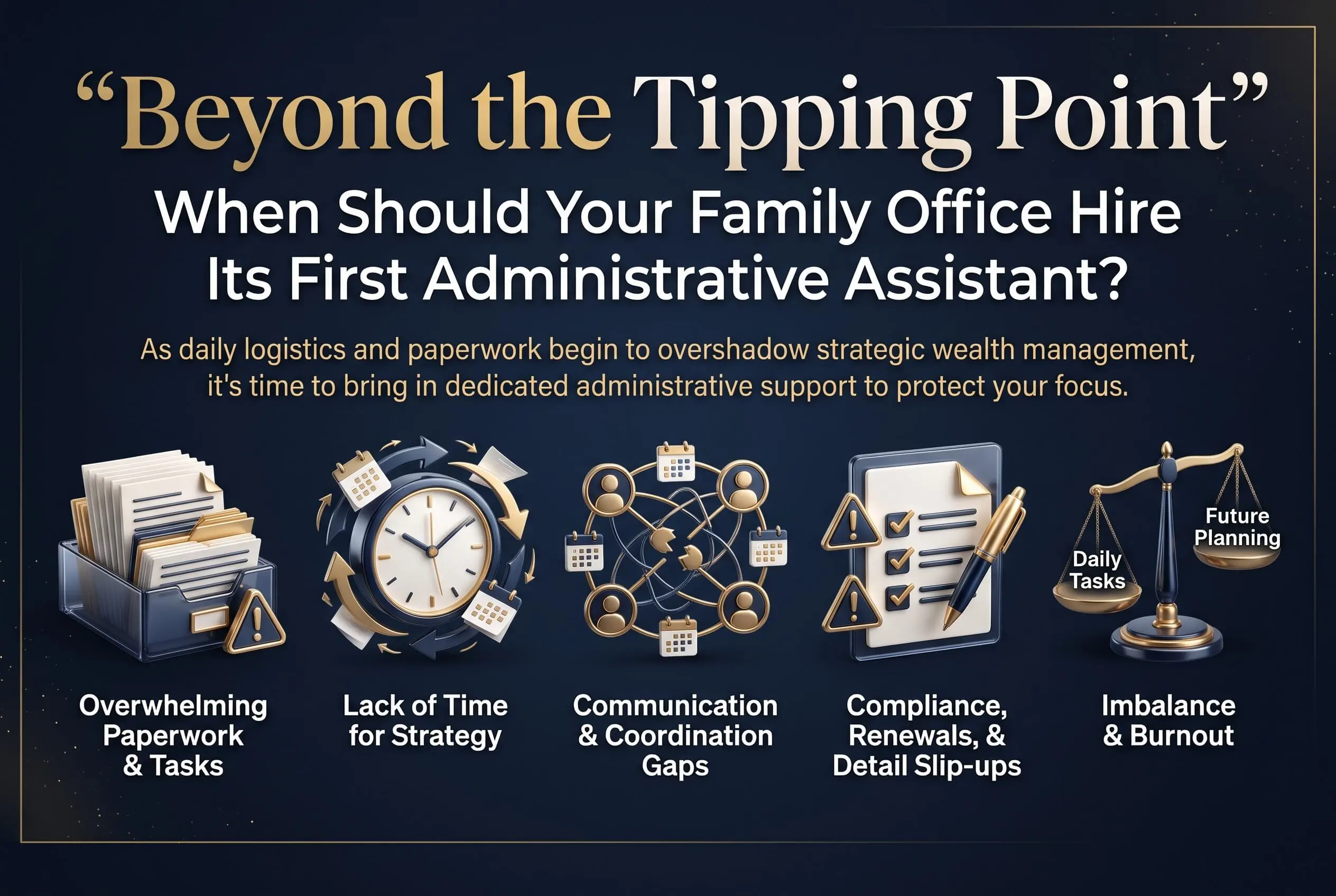
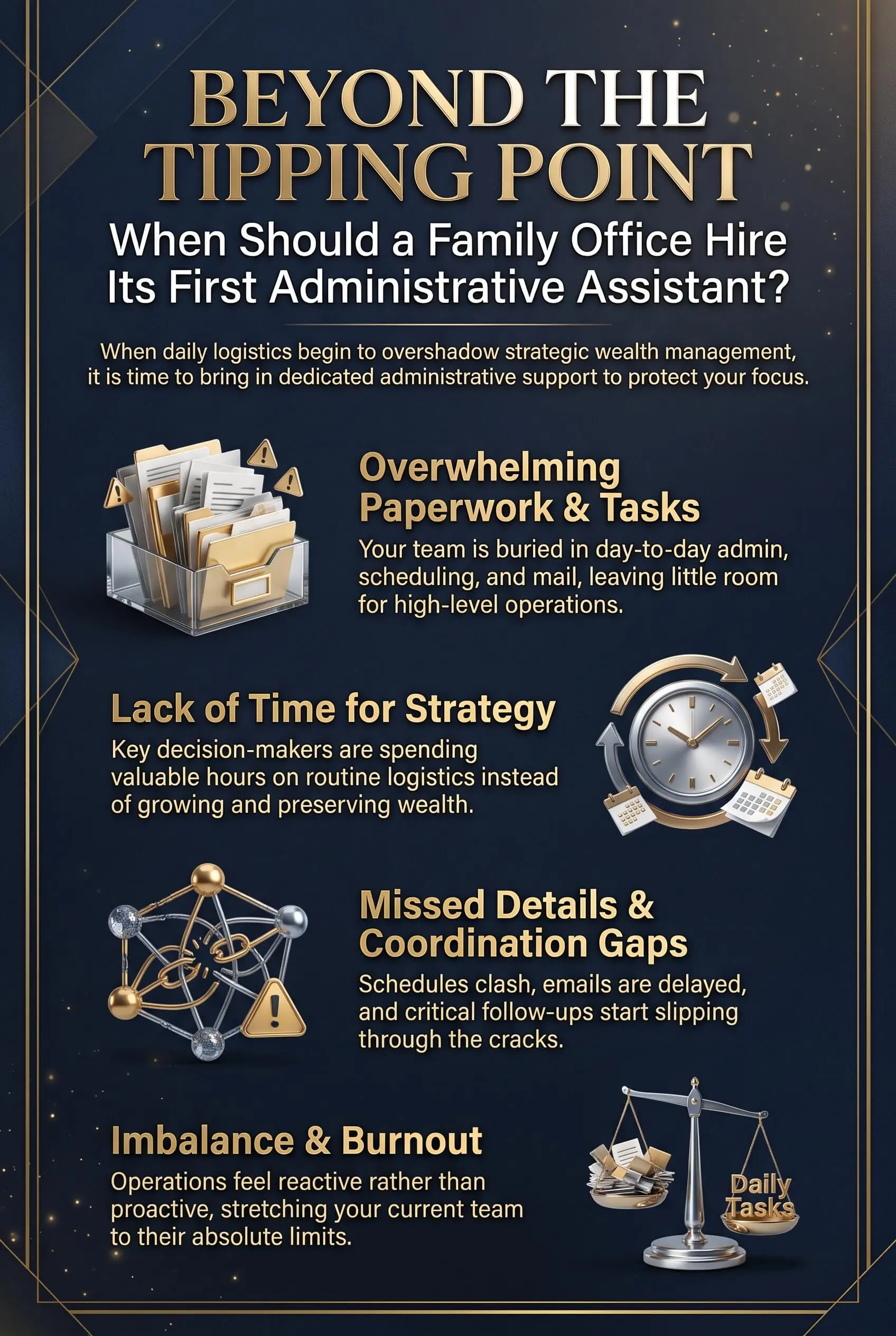
If you see three or more warning signs in a typical week, such as scattered documents, missed deadlines or family members passing messages between advisors, informal administration has run its course.
An in-house assistant costs a median of about $100,000 in base salary and puts a lot of knowledge in one person's hands.
Structured administrative support brings document management, secure vaulting and provider coordination without creating a single point of failure.
Build the system first. A first hire succeeds when there's a clear structure for that person to run.
Signs Your Family Office Needs Administrative Support
What an Administrative Assistant Actually Does in a Family Office
An administrative assistant handles correspondence, scheduling and record-keeping, along with the follow-through that keeps work moving. Inside a family office, the job reaches further. The same person might track an LLC's annual filing in the morning and book a notary for trust documents after lunch.
Get the titles straight before you write a job description. An executive assistant supports one principal directly. A chief of staff holds decision rights and manages people. The administrative assistant runs the system underneath both of them. When families blur those roles, they end up hiring the wrong person or handing the right person the wrong job.
Seven Signals It's Time
Count how many of these describe a normal week in your office. If three or more do, informal administration has run its course.
You hold several LLCs, trusts or residences, and nobody keeps one record of all of them.
Important documents sit in advisor portals, personal inboxes and a filing cabinet.
You missed a renewal, filing or signature deadline at least once in the past year.
Family members carry messages between the CPA, the attorney and the insurance advisor.
The principal spends evenings on paperwork instead of decisions.
You have a business sale, an estate plan update or a relocation coming up.
The next generation's logistics, from school applications to meetings with an educational consultant, land on the same crowded calendar.
Hire, Outsource, or Both
Hiring in-house is a real commitment. Family offices pay executive assistants a median base salary of $100,048 before bonuses, according to a Botoff Consulting survey of 436 offices. That money buys you presence and loyalty. It also puts a great deal of knowledge in one person's head, and sooner or later that person will take a vacation, change jobs or retire.
Structured family office administrative support adds structure and follow-through instead of headcount. Your office gets centralized document management that works as a reliable source of truth, a secure electronic vault with defined permissions, and one point of coordination that gives your CPA, attorney and insurance advisor shared context. Your advisors keep doing the work they do well. A coordinator keeps the lanes between them connected.
Cost: An in-house assistant means a salary, a 10% to 20% bonus, benefits and workspace. Structured support runs on a service fee scaled to your complexity. With the status quo, you pay in principal and advisor hours.
Continuity: An in-house hire depends on one person. A structured system keeps records and workflows intact when people come and go, while the status quo leaves everything in someone's memory.
Coverage: One in-house assistant brings one skill set during business hours. Structured support covers documents, vaulting and provider coordination. The status quo hands the work to whoever has time that week.
Security: With an in-house hire, the family designs its own controls. Structured support starts from defined permissions and handling standards, and the status quo is usually inconsistent.
Oversight: You hire, train and manage an in-house assistant yourself. Structured support gives you one coordinator to work with. The status quo asks for your attention all the time.
Plenty of families use both. The structured system holds the records and coordinates advisors, and an in-house assistant handles the principal's calendar and personal logistics. Bookkeeping follows the same logic, so if the books are part of the strain, read up on what makes a good outsourced accounting partner. Whatever mix you choose, the order you build it in matters.
What to Put in Place Before the First Hire
An assistant can only run a system that already exists. Before you post the job:
List every account, entity, property and key document, and note where each one lives.
Map your advisors and what each one owns.
Write down your recurring obligations: tax deadlines, insurance renewals, entity filings and trust distributions.
Decide who sees what, and set permissions before anyone shares a password.
If that list looks heavy, take the hint. Your office may need structure before it needs another person.
“We see the same pattern when families map their administration for the first time. They give the portfolio most of their attention, yet the friction we find almost always sits in the paperwork. Nobody can locate the operating agreement. A K-1 arrives after the CPA's deadline. Three advisors each assume another one sent the signed trust amendment, and the insurance schedule hasn't been touched since the last property purchase. A sharper investment thesis fixes none of that.”
7 Essential Resources
Staffing the Family Office (Umbrex): This playbook chapter shows how to map capabilities before choosing titles, how to limit key-person risk, and how to decide which work stays in-house.
2026 Global Family Office Report (J.P. Morgan Private Bank): J.P. Morgan surveyed 333 single-family offices on operating costs, staffing and what they insource versus outsource.
Family Office Insights Series, Global Edition (Deloitte Private): Deloitte tracks hiring and outsourcing trends across 354 single-family offices.
Starting a Family Office? Do These Three Things First (Institutional Investor): Advisors explain why a new office should settle governance and operations before portfolio decisions.
Family Offices Are Paying Executive Assistants Up to $190,000 a Year (CNBC via NBC Los Angeles): Recruiters lay out pay ranges, experience expectations and how far the role really reaches.
Secretaries and Administrative Assistants (U.S. Bureau of Labor Statistics): The BLS gives a government baseline for duties, qualifications and pay across the profession.
International Association of Administrative Professionals: IAAP awards the CAP credential, which gives you a useful signal when you vet an in-house candidate.
Supporting Statistics
Lean teams are normal in this world, and good administrative talent costs real money. Families also know the risk of leaning on one person, as these figures show.
$100,048: Botoff Consulting surveyed 436 family offices and family investment firms and found this median base salary for executive assistants. Offices with $2.5 billion or more under management pay about 35% more at the median, and bonuses usually add another 10% to 20%. (CNBC via NBC Los Angeles)
About one in three: Roughly a third of single-family offices told J.P. Morgan Private Bank that overreliance on a single person or provider ranks among their top three risks to continuity. (J.P. Morgan Private Bank, 2026 Global Family Office Report)
15 people, $2 billion: Deloitte Private found the average single-family office manages about US$2.0 billion with roughly 15 staff. In the same survey, 34% planned to rely more on third-party providers as they scale. (Deloitte Private)
These statistics highlight the need for efficient staffing and reliable administrative support in family offices. As responsibilities grow, family foundation management helps streamline charitable activities, coordinate philanthropic advisors, maintain accurate records, and support long-term family legacies.
Final Thoughts
Build the system first. Then hire into it.
An assistant who walks into scattered records and undefined permissions spends the first several months doing archaeology, hunting for documents, figuring out which advisor holds which file and guessing at deadlines nobody wrote down. That's an expensive way to learn what your office needs. And if that person moves on, the family ends up right back where it started.
The families who handle this well treat Family Office Administrative Support as infrastructure. They centralize records, decide who can access what, and make one point of coordination responsible for follow-through. In return they get accountability, coordination, control and time back, and their offices move from reactive to reliable. Once that foundation exists, a dedicated hire becomes a simple call about volume and preference.
Our advice is to hire when the work is steady enough to fill a role and the system is solid enough for someone to run. Until both are true, structure will do more for you than headcount. If leadership is what you're really missing, start with what to look for in a fractional family office CEO.
Family Office Administrative Support FAQs
What does a family office administrative assistant do?
A family office administrative assistant manages the records, schedules and follow-through behind a family's financial life. Day to day, that person organizes documents, tracks filing and renewal deadlines, coordinates signatures and notarizations, and keeps the CPA, attorney and insurance advisor working from the same information.
How much does a family office assistant cost?
Botoff Consulting surveyed 436 family offices and put the median base salary for executive assistants at $100,048. Bonuses usually add 10% to 20%, and you'll also pay for benefits, workspace and management time. Larger offices often pay considerably more.
Should a family office hire in-house or outsource administrative support?
The answer turns on volume and continuity. An in-house assistant works well for a principal's personal calendar and daily logistics. Outsourced, structured support fits records, vaulting and advisor coordination better, because the system outlasts any one employee. Many families use both.
Is a chief of staff the same as an executive assistant?
No. A chief of staff typically holds decision rights, manages people and acts on the family's behalf. An executive assistant supports one principal directly, and an administrative assistant runs the processes and records underneath both roles.
When is the right time to make the first hire?
Hire when administrative work is steady enough to fill a role and your office has a basic structure in place. That means an inventory of accounts and entities, a map of your advisors, a calendar of recurring obligations and defined access permissions.
Does administrative support replace my CPA or attorney?
No. Good administrative support works alongside your existing professionals. It improves organization, communication and follow-through, so your advisors can focus on the work only they can do.
Ready for Less Admin and More Life?
Is your CPA still waiting on a document only you know how to find? Then structure is the right place to start. Legacy Bridge gives families a secure source of truth for critical records, defined permissions and one team accountable for follow-through through our family office concierge services. We work with discretion and steady Midwestern values. Your providers keep their roles, and we keep them aligned and moving. Schedule a private consultation with Legacy Bridge to map where your administration stands today.


