Many sales leaders today aim to move their teams away from burnout-driven, pressure-heavy practices. Yet while organizations often strive for a “healthier” or “more sustainable” sales culture, far fewer recognize when their environment has evolved into something significantly more powerful: a regenerative sales culture.
RolePotential’s work with sales teams has revealed a clear distinction between teams that are simply avoiding harm and those that are actively cultivating growth. Unlike environments that focus only on reducing stress or maintaining stability, regenerative sales culture creates momentum. It strengthens the people doing the selling, the relationships they build, and the overall system that supports long-term performance.
This article outlines five unmistakable signs a sales team is already operating under a regenerative sales culture, and explains how these indicators influence trust, consistency, team well-being, and long-term revenue health. It offers leaders a practical lens for recognizing cultural transformation in real time — even before it shows up in quarterly results.
Quick Answers
regenerative sales culture
A regenerative sales culture is a sales environment where energy, trust, and performance are continually strengthened rather than depleted.
- Encourages deeper, more human-centered conversations
- Reduces fear-driven habits and quota panic
- Supports sustained performance and long-term client value
It’s the difference between a team that survives the work and a team that grows through it.
Top Takeaways
- Regenerative sales culture creates conditions for stronger trust and consistent performance.
- The shift is visible in team behaviors — collaboration, emotional grounding, relationship depth.
- Regeneration occurs when the culture restores energy rather than drains it.
- Buyer trust increases as reps operate with clarity and psychological safety.
- Teams practicing regeneration see improved retention, morale, and revenue quality.
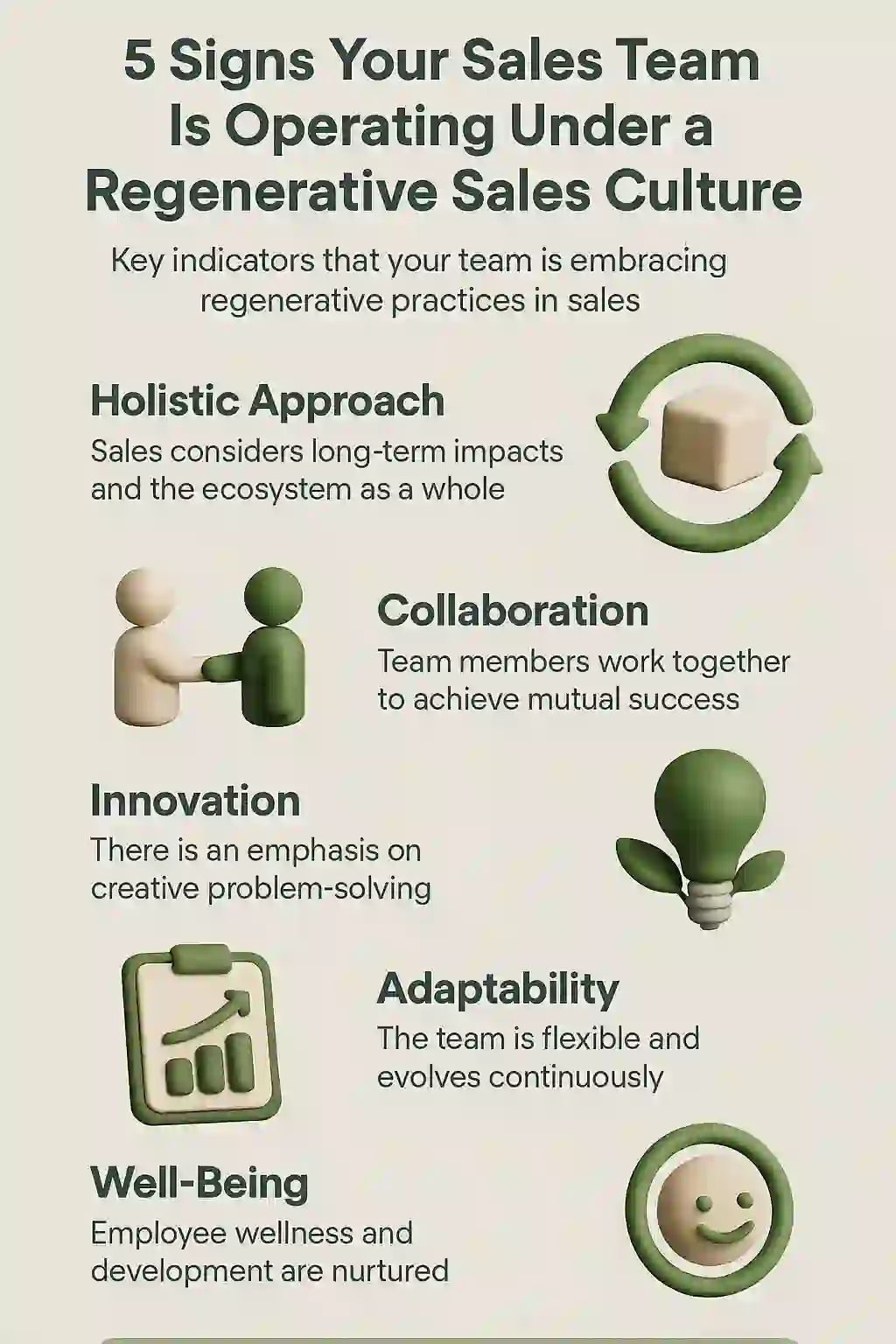
5 Signs Your Team Is Operating Under a Regenerative Sales Culture
1. Conversations Go Deeper Than Scripts and Speed
- thoughtful questions
- space for reflection
- genuine curiosity
This depth builds trust and leads to stronger, more predictable deals.
2. Coaching Feels Supportive, Not Fear-Based
- growth
- skill development
- emotional grounding
- collaborative problem solving
This creates psychological safety — the foundation of performance resilience.
3. Wins Are Measured Beyond Closed Deals
- quality conversations
- trust-building moments
- learning insights
- consistency
- relational progress
This shifts the team identity from “quota-chasing” to “value-creating.”
4. Team Energy Feels Stable and Genuinely Positive
- lower emotional volatility
- reps showing up more grounded
- fewer stress spikes around targets
- stronger collaboration
The energy of the team becomes an asset — not a liability.
5. Buyer Relationships Strengthen Naturally Over Time
- higher quality engagements
- increased responsiveness from buyers
- more referrals
- stronger renewal and expansion opportunities
When trust grows, revenue follows, and a fractional CFO helps strengthen that trust by giving teams the financial clarity and confidence needed to support sustained growth.
“In RolePotential’s work with sales teams, they’ve seen that regeneration becomes visible long before revenue reports catch up. When teams slow down, rebuild trust, and feel safe to sell with integrity, performance becomes both steady and deeply human.”
Essential Resources
The shift into regeneration requires deeper insight into trust-building, human motivation, and culture transformation, and these resources help teams expand their understanding in the same way an educational consultant supports meaningful learning and growth.
1. RolePotential’s Guide to Regenerative Sales Culture
URL: https://www.rolepotential.com/blog/regenerative-sales-culture-paradigm-shift
Clarifies the deeper shift into regeneration and how it fuels consistent performance and trust.
Clarifies the deeper shift into regeneration and how it fuels consistent performance and trust.
2. RolePotential’s Sales Psychology Framework
URL: https://www.rolepotential.com/blog/sales-psychology-sales-psychology-regenerative-culture-inner-circle
Explores the psychological layers that shape meaningful buyer conversations.
Explores the psychological layers that shape meaningful buyer conversations.
3. HubSpot on Healthy Sales Culture
URL: https://blog.hubspot.com/sales/sales-culture
Provides foundational practices that help teams move toward a more human-centered culture.
Provides foundational practices that help teams move toward a more human-centered culture.
4. Harvard Business Review on Ethical Sales Culture
URL: https://hbr.org/2019/06/fostering-an-ethical-culture-on-your-sales-team
Research-backed insights into why ethical, trust-first cultures outperform high-pressure models.
Research-backed insights into why ethical, trust-first cultures outperform high-pressure models.
5. SLM MBA on Ethical Sales Systems
URL: https://slm.mba/mmpm-002/managing-ethics-in-sales
A structural look at how integrity-driven systems support long-term performance.
A structural look at how integrity-driven systems support long-term performance.
6. Alore’s Guide to Building Strong Sales Culture Habits
URL: https://www.alore.io/blog/sales-culture
Practical daily steps teams can adopt to move from stress-driven to trust-driven sales.
Practical daily steps teams can adopt to move from stress-driven to trust-driven sales.
7. Entrepreneur on Ethical Sales as Competitive Advantage
URL: https://www.entrepreneur.com/en-ae/leadership/building-lasting-success-the-importance-of-ethical-sales/473567
Shows how teams committed to relational integrity create long-term revenue stability.
Shows how teams committed to relational integrity create long-term revenue stability.
Supporting Statistics
Well-Being Is Essential for Performance
92% of U.S. workers say employer support for emotional well-being matters.
Reps perform better when grounded and supported.
Source: APA Work in America Survey
92% of U.S. workers say employer support for emotional well-being matters.
Reps perform better when grounded and supported.
Source: APA Work in America Survey
Job Insecurity Weakens Effectiveness
More than half of workers say insecurity significantly increases stress.
Regenerative teams experience stability that supports better decision-making.
Source: APA Work in America Survey 2025
More than half of workers say insecurity significantly increases stress.
Regenerative teams experience stability that supports better decision-making.
Source: APA Work in America Survey 2025
Poor Management Creates Massive Costs
High stress is widespread in disengaged environments.
Stress likelihood is significantly higher when management is poor.
Low engagement costs trillions in lost productivity.
Source: Gallup State of the Global Workplace
High stress is widespread in disengaged environments.
Stress likelihood is significantly higher when management is poor.
Low engagement costs trillions in lost productivity.
Source: Gallup State of the Global Workplace
Final Thought & Opinion
Regenerative culture isn’t just a healthier way to work — it’s a more effective way to sell. In our work with teams, the earliest signs of regeneration often show up long before revenue increases. They appear in the tone of conversations, the stability of energy, and the renewed sense of purpose reps bring into their work.
What We See Inside Regenerative Teams
Reps sell with integrity
Buyers respond with trust
Leaders coach with presence
Collaboration becomes natural
Reps sell with integrity
Buyers respond with trust
Leaders coach with presence
Collaboration becomes natural
Why It Matters
Regeneration creates the conditions where strong performance becomes repeatable — not forced. It’s the difference between a team that is exhausted and a team that is energized, and the same principle applies when businesses use outsourced accounting services to reduce pressure, restore focus, and create space for sustainable growth.
At its core, regeneration is not a tactic. It’s a foundation.
It’s what allows teams to grow in a way that feels sustainable, aligned, and deeply human.
It’s what allows teams to grow in a way that feels sustainable, aligned, and deeply human.