
A trust only controls the assets titled to it. That one fact explains why families with a well-drafted estate plan still end up calling banks and waiting on probate.
It usually surfaces on a weeknight. A parent lands in the hospital, and someone needs the health care directive tonight. One sibling thinks it's in the fireproof box. Another is sure the attorney has it, and the 2017 trust binder sits somewhere in the basement next to a safe deposit key nobody can place.
Keeping estate planning documents organized in one place comes down to two habits. Store the documents together with a written map of how each asset is titled and who inherits it. Then check that map on a schedule, so the paper and the accounts keep telling the same story. A binder gets you started, but the map and the reviews do most of the work.
That second habit is where families lean on a team that handles estate planning coordination. They treat the plan as something to maintain rather than a stack of papers signed once and filed. Your attorney still drafts the documents, and your CPA still handles the tax side. Someone has to confirm that the accounts, titles, and beneficiary forms match what those documents say.
In our experience, setting it up takes a focused weekend. After that, an afternoon or two a year keeps it current, plus a quick check whenever something big changes.
TL;DR Quick Answers
Estate Planning Coordination
Estate planning coordination keeps a family's will, trust, and powers of attorney matched to how its accounts and properties are titled and who is named as beneficiary. It turns a signed plan into a maintained one, with one person accountable for follow-through while the attorney and CPA lead on legal and tax decisions.
What it covers:
Document inventory: every legal document, amendment, and supporting record in one place
Trust funding checks: accounts and property titled the way the plan intends
Beneficiary alignment: retirement accounts and insurance policies consistent with the trust
Access planning: your executor, trustee, and agents know where everything is
Scheduled reviews: an annual check, plus updates after major life events
What to confirm:
Every entry on your asset-to-document map carries a "last verified" date
Original wills and trusts sit where your executor can reach them
One named person owns each open item until it's closed
This is organizational guidance, not legal, tax, or investment advice. Confirm specifics with your estate attorney and CPA.
Top Takeaways
Keep legal documents, asset records, and guidance letters together in one clearly labeled place.
Build an asset-to-document map so every account, property, and policy points to the document that governs it.
Compare every beneficiary form against your trust at least once a year.
Keep originals secure and digital copies encrypted, labeled the same way in both places.
Tell each person with a role, in writing, where the documents live and how to reach them.
Review the whole system annually and after every major life event.
Name one person to own the follow-through, whether a family member or a coordination professional working alongside your attorney and CPA.
Why Estate Plans Drift Between Paper and Practice
Weak documents are seldom the culprit when a plan breaks down. More often, the accounts and titles moved and the paper stayed put.
Estate planning sets out how your assets get managed if you can't act and where they go when you die. Your will and trust record the intent. A retirement account, though, pays whoever is named on its beneficiary form, and a house follows its deed. Sign a revocable trust without retitling the brokerage account into it, and the trust may have no say over that account at all.
The drift is quiet. A refinance, a new account, a job change, a child turning 18. Each one nudges the plan a little further from the paper, and good organization lets you spot the gap before your family has to sort it out in probate court.
What Belongs in Your One-Place Estate Planning System
Four kinds of records belong in your one place: the legal documents, the asset records they rely on, guidance for your family, and a short digital inventory.
Core Legal Documents
Will, plus any codicils
Revocable living trust, every amendment, and the certification of trust
Durable financial power of attorney
Health care directive, health care power of attorney, and HIPAA release
Guardianship nominations for minor children
Business entity documents such as operating agreements and buy-sell agreements
Asset Records
Deeds and property titles, including anything out of state
Recent statements for bank, brokerage, and retirement accounts
Life insurance and annuity policies
529 plans and other education savings accounts
Vehicle titles and any loans tied to them
Guidance Documents
A letter of instruction that says where things are and who to call
Letters of wishes for tangible family items, like jewelry, art, or the farm equipment everyone has opinions about
Funeral and burial preferences
The Digital Layer
A list of online accounts and digital assets
Emergency access in your password manager, so a trusted person can get in without your login on a sticky note
The Asset-to-Document Map That Makes Everything Findable
Most families skip the map. It also does more work than anything else in the file. Each entry names an asset, who owns it, how it passes, and which document governs it.
Brokerage account: Titled to the Family Revocable Trust and passes through trust administration under the 2023 amendment. Last verified March 2026.
401(k): Owned by the account holder and passes by beneficiary designation to the spouse, then the children equally. Governed by the plan's beneficiary form, last verified March 2026.
Lake house: Deeded to the Family Revocable Trust and passes under the trust's terms. Deed last verified March 2026.
When the map and the documents disagree, you've caught the problem early enough to fix it. A beneficiary form that still names an ex-spouse, or a property titled in a late parent's name, turns up after about five minutes of reading.
Where to Keep Estate Planning Documents Safely
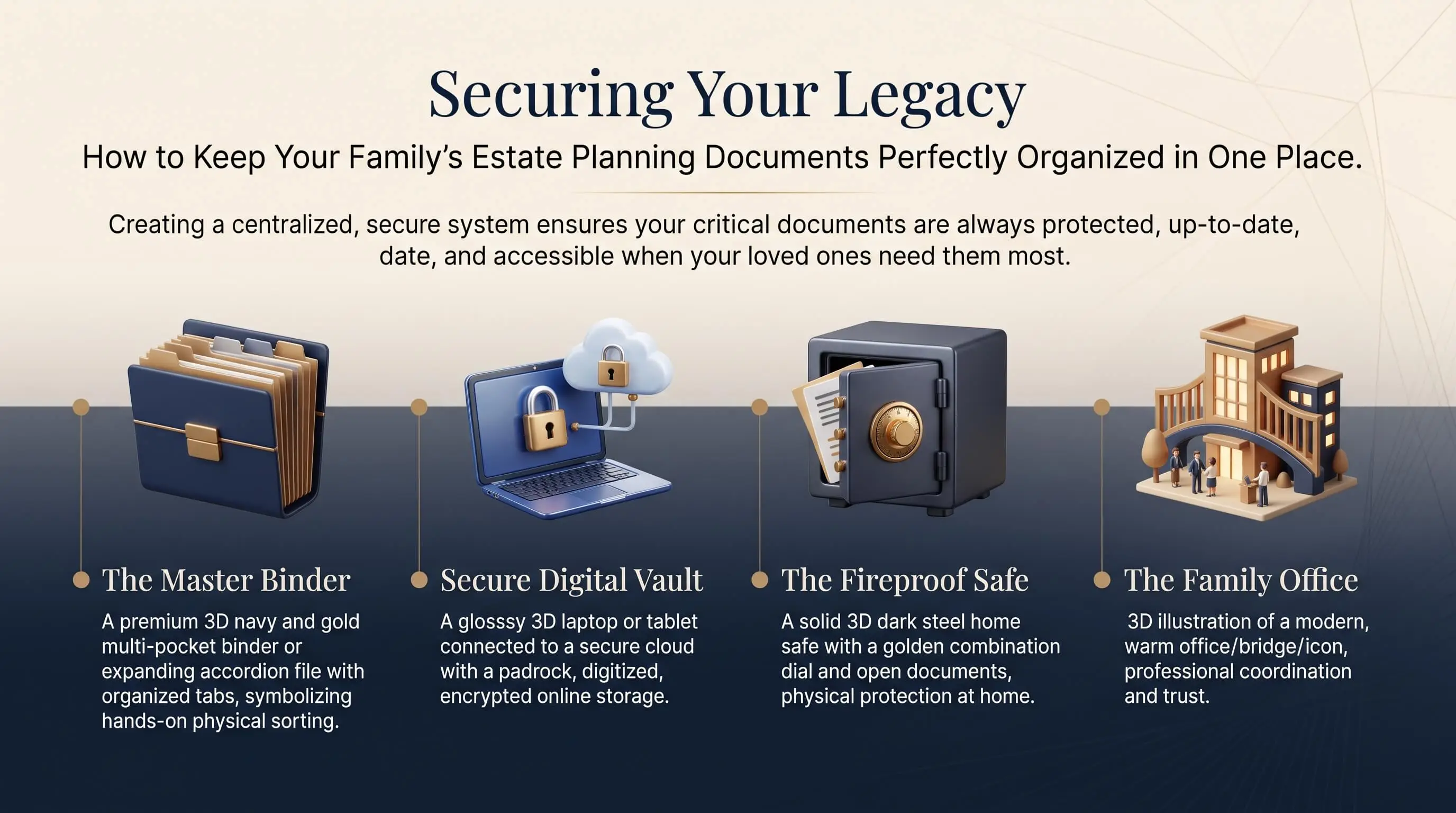
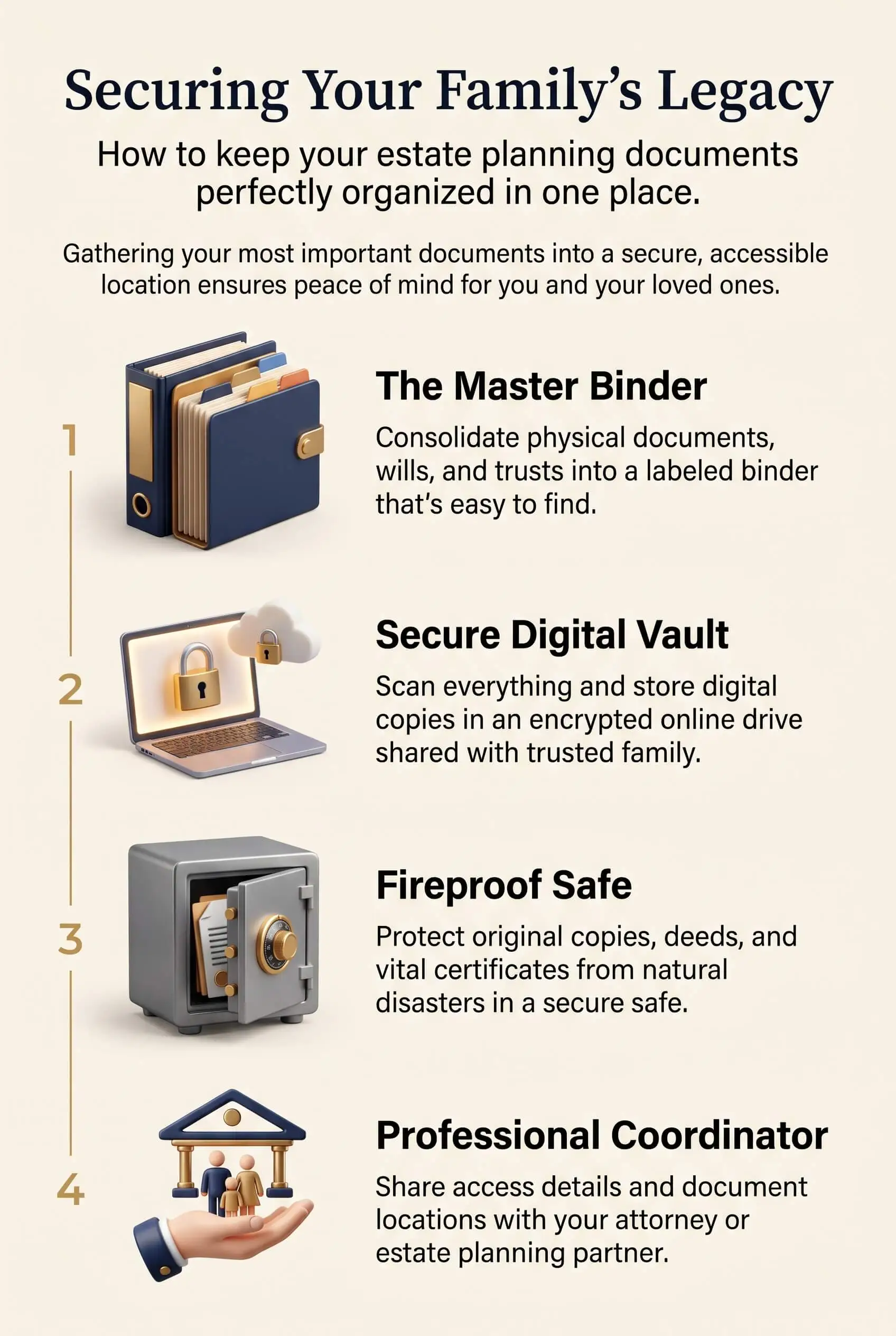
Your originals need a home that's secure and that your family can reach. Scanned copies go in an encrypted digital vault.
Home safe rated for fire and water. Good for originals your family will need fast. Write down who knows the combination.
Safe deposit box. Secure, though access can stall after a death or incapacity depending on your state and how the box is titled. Check with your attorney before storing an original will there.
Your attorney's office. Many attorneys keep original wills on file. Ask for a written receipt and put a copy of it in your binder.
Encrypted digital vault. Scan everything, label files to match your physical folders, and set access by role.
Whatever mix you land on, label consistently. "Trust, 2023 amendment" should point to the same document in the folder and in the vault.
Who Should Know Where Everything Is
Only a few people need full copies. Everyone with a role needs to know where the documents live and how to reach them.
Executor and successor trustee: where the originals are, vault access, and the asset map
Agent under your financial power of attorney: the account list and recent statements
Health care agent: the health care directive and HIPAA release, kept easy to grab
CPA and estate attorney: current copies, updated after every change
Guardian you've nominated: the guardianship nomination and a short letter about your children's routines, schools, and care
Put the location and access steps in writing. "It's in the office" has a way of disappearing right when someone needs it. This is especially important in family foundation management, where clear documentation and access instructions help ensure continuity and effective oversight of important records.
How Estate Planning Coordination Keeps the System Current
Estate planning coordination is the ongoing work of keeping your documents matched to your accounts, titles, and beneficiaries, with one person accountable for the follow-through.
Your attorney and CPA stay the technical experts, and coordination sits between them. That means tracking each open item, verifying trust funding after signing, and keeping beneficiary designations aligned with the plan. Some families handle it themselves. Others bring in a Personal CFO or hire a fractional family office leader to own it, the same logic business owners apply when choosing an outsourced accounting partner, stretched across the family's whole picture.
Plan a full review once a year. Add another whenever something like this happens:
A birth, adoption, marriage, divorce, or death in the family
A move to another state
Buying or selling real estate
Selling or restructuring a family business
A child turning 18 or heading to college
A new account, a new policy, or a job change
Build Your One-Place System in Four Steps
Inventory and review. Pull every document and statement into one stack, and note what's missing or out of date.
Map it. Fill in the asset-to-document map, one entry per account, property, and policy. Flag every mismatch.
Store it and assign access. Put originals in their chosen home, scan everything into the vault, and write down who can reach what.
Calendar the reviews and verify changes. Set the annual review date now. After every fix, update the map and its "last verified" date.
"Almost every family I sit down with already has the documents they need. The gap is between those documents and the accounts. The trust reads beautifully, and then we pull the beneficiary forms and find a 401(k) still naming someone from twenty years ago, or a lake property that never got deeded into the trust. So my first step never changes. Every beneficiary form goes on the table next to the trust, and we read them side by side. It takes an afternoon. In my experience, it catches more problems than any other review we run. Then we decide who owns the follow-up, because a mismatch everyone notices and nobody fixes is still a mismatch."
7 Essential Resources
Nolo: Practical Estate Planning, Organize Your Documents: A plain-language guide to the practical side of estate planning, including how disorganized assets can end up unclaimed.
Charles Schwab: How to Store Estate Planning Documents: Where to keep originals and copies, and how to let the right people know where they are.
LPL Financial: Estate Planning Checklist: Helps you spot missing pieces and pull account titles, deeds, and advisor contacts into one starter file.
Experian: Where Should You Store Estate Planning Documents?: Weighs physical against digital storage and explains why files on a computer should be encrypted.
IRS: Estate and Gift Taxes: The federal ground rules your CPA and estate attorney plan around.
NAUPA Unclaimed Property: A free way to check whether any state is holding forgotten accounts in your family's names. Run it during the inventory step.
What Should You Look for in a Fractional Family Office CEO?: Our companion guide for families who want one senior person to own the coordination.
Nolo and the LPL checklist will get your file started. Run the NAUPA search during inventory to catch anything that slipped away over the years.
3 Statistics
Most people still haven't acted. In the Trust & Will 2026 Estate Planning Report, 73% of Americans called estate planning personally important, yet will ownership fall from 31% in 2025 to 26% in 2026. Among people with a will, 41% also hold a medical power of attorney and 28% have a trust. These documents tend to travel together, so store and review them together.
Loose ends cost families money. About 1 in 7 Americans has unclaimed property, and state programs returned more than $4.49 billion to owners in fiscal year 2024, according to the National Association of Unclaimed Property Administrators. Dormant accounts and unpaid life insurance benefits are common examples. An up-to-date asset map is the simplest defense.
Older households are slipping too. Boston College's Center for Retirement Research found that the share of households over 70 with a will or trust dropped from 73% to 64% between 2000 and 2020, as reported here. The families closest to needing their plan aren't always the ones keeping it current.
Final Thoughts and Opinion
A binder is a fine place to start, though it won't keep itself current.
In my experience, the families who hand things off smoothly treat organization as a habit, whatever the size of the file. They update the map after a refinance and pull the beneficiary forms every year, even when nothing seems to have changed. Each open item has a named owner on the family's team. That person closes it.
That habit is what estate planning coordination comes down to. Your attorney writes the plan and your CPA keeps it tax-aware, while coordination keeps it true to the accounts and properties you own today. Paper to practice, and kept there.
The tools come with trade-offs. A digital vault is convenient, but it's only as good as the access you set up, and a password nobody can find helps no one. A safe deposit box is secure, yet it can be the hardest place to reach at the worst possible moment. Most states still give weight to the original will, so don't scan it and toss it.
If you take one thing from this guide, make it that afternoon with the beneficiary forms and the trust side by side. It's quiet, unglamorous work, and it keeps your family from finding a mismatch after it's too late to fix.
Frequently Asked Questions
What is estate planning coordination?
Estate planning coordination is the ongoing work of keeping your legal documents matched to how your assets are titled, who your beneficiaries are, and who can act for you. It covers confirming trust funding, reviewing beneficiary forms, and tracking each update until it's done. Your estate attorney and CPA stay in place, and coordination works alongside them.
What estate planning documents should be kept together?
Keep your will, trust and all amendments, financial power of attorney, health care directive, HIPAA release, and guardianship nominations together. Add the asset records they depend on, such as deeds, account statements, insurance policies, and business agreements. A letter of instruction and an asset-to-document map make the set far easier to use.
Where is the safest place to keep an original will?
Many families use a home safe or leave the original with their estate attorney and keep a written receipt. A safe deposit box is secure, but access after a death or incapacity can be slow depending on your state and how the box is titled. Ask your attorney which option works best where you live.
Who should have access to our estate planning documents?
Your executor, successor trustee, financial agent, and health care agent should know where the documents are and how to reach them. Your attorney and CPA should hold current copies. Give every person with a role written access instructions, even if they never get a full set.
How often should we review and update our estate documents?
Review everything at least once a year. Add a review after a birth, marriage, divorce, death, move to another state, property sale or purchase, business sale, or new account. Update the asset map each time something changes so its "last verified" dates stay current.
Should education accounts and guardianship papers go in the same file?
Yes. Your 529 plans, education trusts, and guardianship nominations all answer the same question about who cares for your children and how, so they belong in one system. If an educational consultant is helping plan your child's path, add their contact details to your letter of instruction.
Bring Your Family's Estate Documents Into One Place This Year
Start small this month, and put a review date on the calendar before you close the folder.
Pull every estate document and recent statement into one stack this weekend.
Build your asset-to-document map, one entry per account, property, and policy.
Lock up the originals, scan the rest into an encrypted vault, and write down who can reach what.
Set your annual review date, and decide who owns the follow-up.
Have a question about organizing your family's estate documents? Leave it in the comments below. And if someone in your family has been quietly keeping track of all of this alone, send this their way. Family office concierge services can also help simplify the process by coordinating estate documents, financial records, and advisors to keep everything organized and aligned.


