Both reactions are normal, and so is quiet relief. Internal Family Systems move at whatever pace your protective parts will allow, so the first week after an IFS therapy session usually tells you more about those parts than about results.
If you'd like a fuller picture before your next appointment, here's a plain-language look at what IFS therapy and parts work actually involves. The hours and days after that first conversation get far less attention than the session itself, and they're often when people start wondering whether something went wrong.
TL;DR Quick Answers
IFS Therapy
IFS therapy, short for Internal Family Systems, is a talk therapy that helps you get to know the different parts of yourself instead of fighting them. Richard Schwartz developed it in the 1980s.
The core idea: your mind holds parts, including protective managers and firefighters and the hurt exiles they guard, plus a calm center IFS calls Self.
How sessions feel: slow and curious. Nothing gets forced, and painful memories wait until your protective parts agree.
After a first session: feeling tired, tender, or hearing a louder inner critic for a few days is common, and it usually settles.
What the evidence shows: support is strongest for depression, and the first randomized trial of a group IFS program for PTSD came out in 2026.
Top Takeaways
Mixed Feelings Are Normal After A First IFS Session. Tired, tender, lighter, or numb all fall within the usual range.
Feeling Worse Usually Means A Protector Noticed. IFS calls it backlash, and it tends to settle within a few days.
Week One Is Orientation. Deep memory work shouldn't happen yet, and a good therapist won't push for it.
Noticing Is Enough Between Sessions. Two lines a day about what showed up gives you plenty to bring back.
Exiles Wait For The Room. Leave painful memories alone until you're back with your therapist.
Say What Felt Off Before You Quit. About 1 in 5 adults leave therapy early. Telling your therapist what bothered you gives the work a chance to adjust.
What Happens In Your First IFS Therapy Session
Richard Schwartz developed Internal Family Systems in the 1980s after noticing how often his clients talked about themselves in the plural. Part of me wants to quit this job, and part of me is scared to. IFS calls those voices parts, and it holds that beneath them sits a steadier center, called Self, that can listen to them without panicking.
Your first session is mostly orientation. Expect questions about what brought you in, a conversation about consent and pacing, and maybe a first try at noticing a part. Even the nervous one that almost made you cancel counts.
Nobody should ask you to go into your hardest memories in week one. IFS starts with the parts that protect you and leaves the pain they guard alone until they're ready.
How You Might Feel In The Hours And Days After
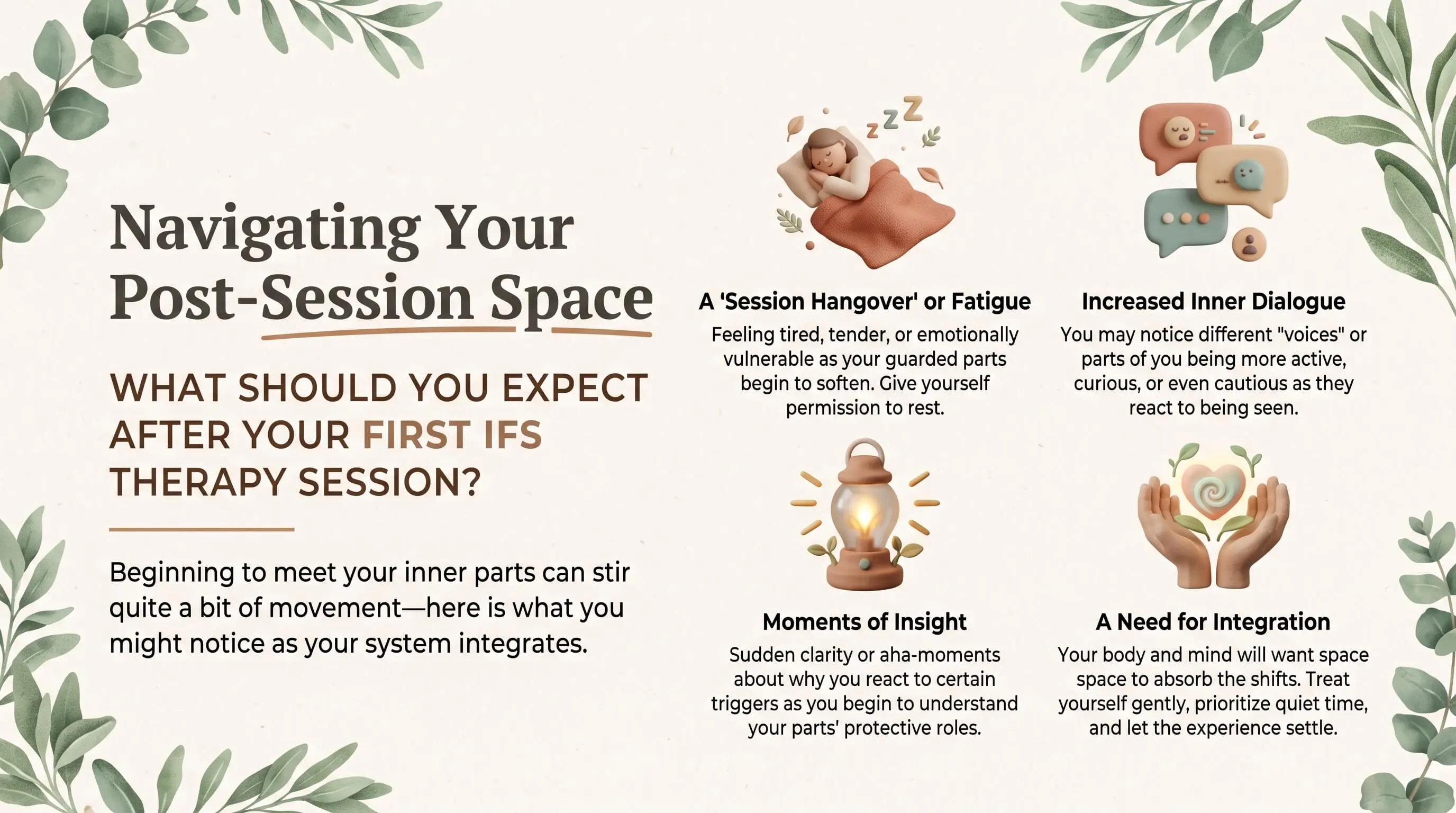
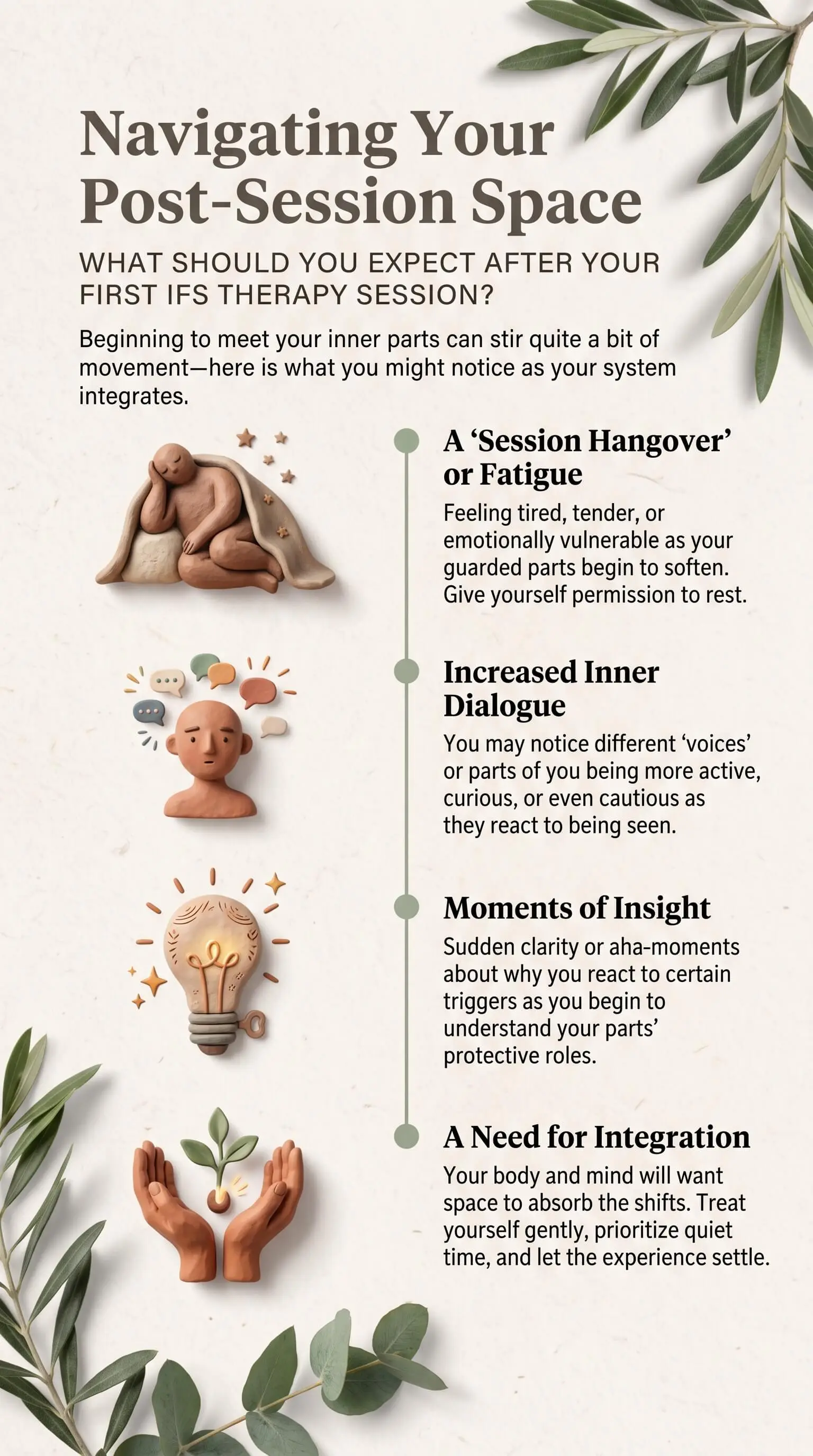
Feeling worse after an IFS session is common. Usually it means you turned toward a part that has worked hard for years without much attention, and that part is reacting. The reaction tends to settle within a few days.
Here's what people describe most often.
Wiped Out. Paying close attention to your inner world takes more energy than it looks like. An early night is a reasonable response.
Raw Around The Edges. A part that rarely gets listened to was heard for an hour. Small things might bring tears for a day or two.
Lighter Than You Expected. Some people compare it to putting down a bag they'd carried so long they forgot it was there.
Numb, Or Nothing. Often this is a protector deciding one session was plenty for now. Flat is information too.
Replaying What You Said. People call this a vulnerability hangover. A part that keeps you safe by keeping things private may be uneasy that you opened up.
Why Protective Parts Sometimes Push Back
IFS sorts parts into a few rough roles. Managers try to stop anything from going wrong, so the planner and the inner critic usually live there. Firefighters show up fast when pain breaks through, whether that looks like numbing out, snapping at someone, or two hours of scrolling. Exiles hold the older hurt that the other two work so hard to keep quiet.
A protector you've just noticed can get louder for a few days. IFS calls this backlash, and it's closer to a part testing the water than a sign you've gone backward.
Critics of IFS raise a fair point here. When a therapist moves past protectors too quickly, parts work can destabilize people, especially those with complex trauma. The answer is respecting the pace protectors set, which is why early sessions often feel slower than people expect.
What To Do Between Your First And Second Session
You don't need homework. A few small habits are enough.
Leave some room after the session. If you can, skip the hard meeting or errand that was going to follow it.
Notice without fixing. When a feeling shows up, see it and let it stay.
Try three words once a day. Put "a part of me" in front of what you're feeling and see if anything loosens.
Write two lines down. What showed up, and when. Putting it on paper slows the mind the same way regular reflective reading strengthens brain connectivity.
Bring anything that feels like too much to your next appointment. And leave painful memories and exiled parts alone in between. That work goes better with someone in the room.
What Your Next Few IFS Sessions Usually Look Like
Sessions two through four often focus on getting to know a single protector, including what it does and what it's afraid would happen if it stopped.
You'll probably practice unblending, the shift from being inside a feeling to sitting next to it. "I'm anxious" becomes "a part of me is anxious," and the room gets a little bigger. Some people get their first clear moment of Self here, a calm curiosity toward a part they've spent years fighting.
Deeper work with exiles, including what IFS calls unburdening, comes later and only with protectors on board. Some people notice a shift within a handful of sessions. Others work for a year or longer, and neither pace means you're doing it wrong.
How To Tell Whether IFS Therapy Is A Good Fit
Fit matters more than technique. After your first IFS therapy session, check whether you felt heard even when you weren't sure what you were saying, and whether anything moved faster than you wanted.
Asking about training is fair too. The IFS Institute runs Level 1, 2, and 3 training plus a separate certification, and its directory lets you filter by both. It's the same habit as vetting any professional by training and fit before you sign on.
When To Reach Out Before Your Next Session
Most post-session feelings ease within a few days. Call your therapist sooner if you've felt flooded for several days running, you're losing chunks of time, or you've barely slept.
If you have thoughts of harming yourself, call or text 988 in the U.S., or dial 911 if you're in immediate danger.
"Almost every second session I've had starts with some version of 'I think I did it wrong.' Someone felt flat all week, or cried in the parking lot, or snapped at their partner on Tuesday and couldn't say why. I've stopped hearing any of that as a problem. Usually it's a protector reacting to being noticed, and that reaction is exactly where we pick up next. I'd much rather hear about a rough week than have someone quietly cancel. Nobody passes or fails a first session. A few parts of you just got their first look at who they'll be working with."
7 Essential Resources
Worth bookmarking before your next appointment, whether you're still deciding or already booked.
Find An IFS-Trained Therapist Near You Or Online
The official directory of practitioners, which you can filter by training level and certification. The Institute doesn't verify licenses itself, so confirm credentials with anyone you contact.
Source: IFS Institute
See Where IFS Research Stands Right Now
A candid summary from the organization that trains IFS therapists, including the places where the evidence is still thin.
Source: IFS Institute
Look Up A Term Your Therapist Used
Blending, burdens, Self, unburdening. The glossary gives a short definition for each, which helps when a word went by too fast in session.
Source: IFS Institute
Learn What Should Happen In Therapy, And What Shouldn't
The APA explains how therapy usually unfolds, why people sometimes feel worse before they feel better, and how to bring it up if things aren't working.
Source: American Psychological Association
Compare IFS With Other Approaches
NAMI lays out CBT, DBT, EMDR, and psychodynamic therapy side by side. Useful if you're weighing IFS against something a friend swears by.
Source: National Alliance on Mental Illness
Read A Plain Guide To First Sessions In General
Simply Psychology covers what therapists are listening for early on and why so many people walk out of a first session tired.
Source: Simply Psychology
Know Where To Turn If A Hard Week Gets Harder
Free, confidential support by call, text, or chat, any hour of the day.
Source: 988 Suicide & Crisis Lifeline
3 Statistics
The research on IFS is younger than most people assume. These figures show where it stands, and why one hard session shouldn't decide anything.
IFS Has Its First Randomized Controlled Trial For PTSD
Researchers at Cambridge Health Alliance, a Harvard Medical School affiliate, randomized 60 people with PTSD to either a 16-week group program built on IFS or an active comparison program.
Both groups saw large, statistically significant drops in PTSD symptoms, and the IFS-based group had higher attendance and patient satisfaction.
One trial won't settle anything. Still, the program ran for 16 weeks by design, which says a lot about how slowly this work is meant to move.
Source: IFS Institute
Depression Has The Strongest IFS Evidence So Far
A 2016 pilot study of college women with depression randomly assigned 17 participants to IFS and compared them with a treatment-as-usual group.
The IFS Institute says depression is the only condition so far with statistically significant improvement across multiple pilot randomized trials.
The Institute also says the risk of harm hasn't been studied systematically yet.
Promising and proven are different words. A therapist who tells you that plainly is one worth keeping.
Sources: IFS Institute pilot study summary and IFS Institute research overview
About 1 In 5 Adults Leave Therapy Early
A 2012 meta-analysis by Joshua Swift and Roger Greenberg found an average dropout rate of 19.7%, drawing on more than 650 studies and over 83,000 clients.
Dropout rates shifted with the treatment setting, a hint that fit and environment affect who stays.
If your first session left you unsure, say so before you stop. Saying it out loud is part of the work.
Source: GoodTherapy
IFS therapy research is still developing, with early studies showing promising results for PTSD and depression, while nearly 1 in 5 adults leave therapy early. These findings highlight why finding the right therapist and feeling comfortable with the process matter. Choosing professional support is a personal decision, much like consulting a private school consultant when evaluating educational options. In both situations, understanding individual needs, asking the right questions, and taking time to find the right fit can make the decision more informed.
Final Thoughts And Opinion
A first IFS session can leave you with more questions than answers, and I'd argue that's the right outcome. Whatever showed up in the days after, whether that was tears or a critic that suddenly got louder, it's telling you how your system learned to protect you.
Here's where I land, including the parts that are harder to say.
A Rough First Week Doesn't Mean A Bad First Session. Some protectors quiet down once they're noticed, and others get louder for a while. Both are workable with a therapist who's paying attention.
Slow Is The Safety Feature. The fair criticism of IFS is that moving past protectors too quickly can destabilize people. I agree with it, and I'd be wary of any early session that felt rushed.
The Evidence Is Promising And Young. Depression has the most support so far, and trauma research is growing. Anyone calling IFS proven for everything is overselling it.
You're Allowed To Choose On Fit. Tell your therapist if you didn't feel heard. If it still feels off after that conversation, finding someone else is a reasonable call and says nothing bad about you.
You noticed a part of yourself, maybe for the first time in years. That's small, and it's a good place to start.
Frequently Asked Questions
Q: Is It Normal To Feel Worse After An IFS Therapy Session?
A: Yes, and it usually passes within a few days. Parts that have protected you for years can stir when someone finally pays attention to them. If it lasts more than a week or feels unmanageable, contact your therapist before your next appointment.
Q: What Should I Do After My First IFS Session?
A: Give yourself some quiet time and let whatever shows up be there without fixing it. Jotting a couple of lines each day gives you something concrete to bring to your second session.
Q: How Many IFS Sessions Does It Take To Notice A Change?
A: It depends on the person, and an honest therapist won't give you a number. Some people feel a small shift within a handful of sessions, often the first time they can sit beside a feeling instead of inside it. Bigger changes usually take months.
Q: What Happens In The Second IFS Therapy Session?
A: Most second sessions start with a check-in about the week, then turn toward one protective part. Your therapist may ask where you feel it in your body and what it worries would happen if it stepped back.
Q: Can IFS Therapy Bring Up Memories I Wasn't Expecting?
A: Sometimes, though IFS isn't designed to dig for them. The model waits for protective parts to agree before approaching painful material. If something surprising surfaces, tell your therapist and don't push further on your own.
Q: How Do I Know If IFS Therapy Is Working?
A: Look for small shifts in how you relate to yourself. You might catch yourself saying "a part of me" in a hard moment, or feel curious about your inner critic when you'd normally argue with it. Space tends to arrive before relief does.
Q: Is IFS Therapy Evidence-Based?
A: Partly. Small randomized trials support IFS for depression, and the first randomized trial of a group IFS program for PTSD came out in 2026. The IFS Institute itself says larger trials are still needed and that the risk of harm hasn't been studied systematically.
Q: Can IFS Therapy Be Done Over Telehealth?
A: Yes. IFS relies on talking and turning inward, and both travel well over video. Being in a familiar space can even make it easier to slow down. For people managing significant health issues that make travelling to appointments difficult, online IFS therapy can also provide a more accessible way to receive professional mental health support.
Bring What You Noticed To Your Next Session
Whatever came up this week belongs in the room, even if all you have is a word or two scribbled on a receipt. Say it early in the session, before a careful part talks you out of it. Just as an educational consultant helps families work through difficult school decisions, an IFS therapist can help you explore conflicting feelings and understand what's holding you back.
If you're still looking for an IFS therapist, Lauren Rath offers a free 15-minute call to see whether the fit feels right, with no pressure either way.
Leave your questions about the first IFS session in the comments below.