In a lot of families, one parent has carried the whole financial picture in their head for decades. They know which trust holds the farmland, when the CPA needs the K-1s, and which drawer has the original estate documents. The trouble starts the week that the parent steps back and everyone else has to figure out where anything is.
Most families go looking for a fractional family office CEO right around then.
The right candidate has spent years inside family offices and knows how to keep your CPA, attorney, and investment team working from one plan. They'll put a fiduciary commitment in writing and give you reports you can actually act on. They'll also handle family disagreements and private documents with a steady hand, and they'll agree on a clear scope before any work begins. Credentials count, though follow-through counts for more.
Some firms call this person a fractional family office president, a Personal CFO, or a family office director. Whatever the title, you're hiring one senior person to keep your advisors aligned and your decisions moving.
Families comparing outsourced family office executive services tend to judge candidates on the same short list of qualities, and each one comes with a question worth asking in the first meeting.
TL;DR Quick Answers
Outsourced Family Office Executive Services
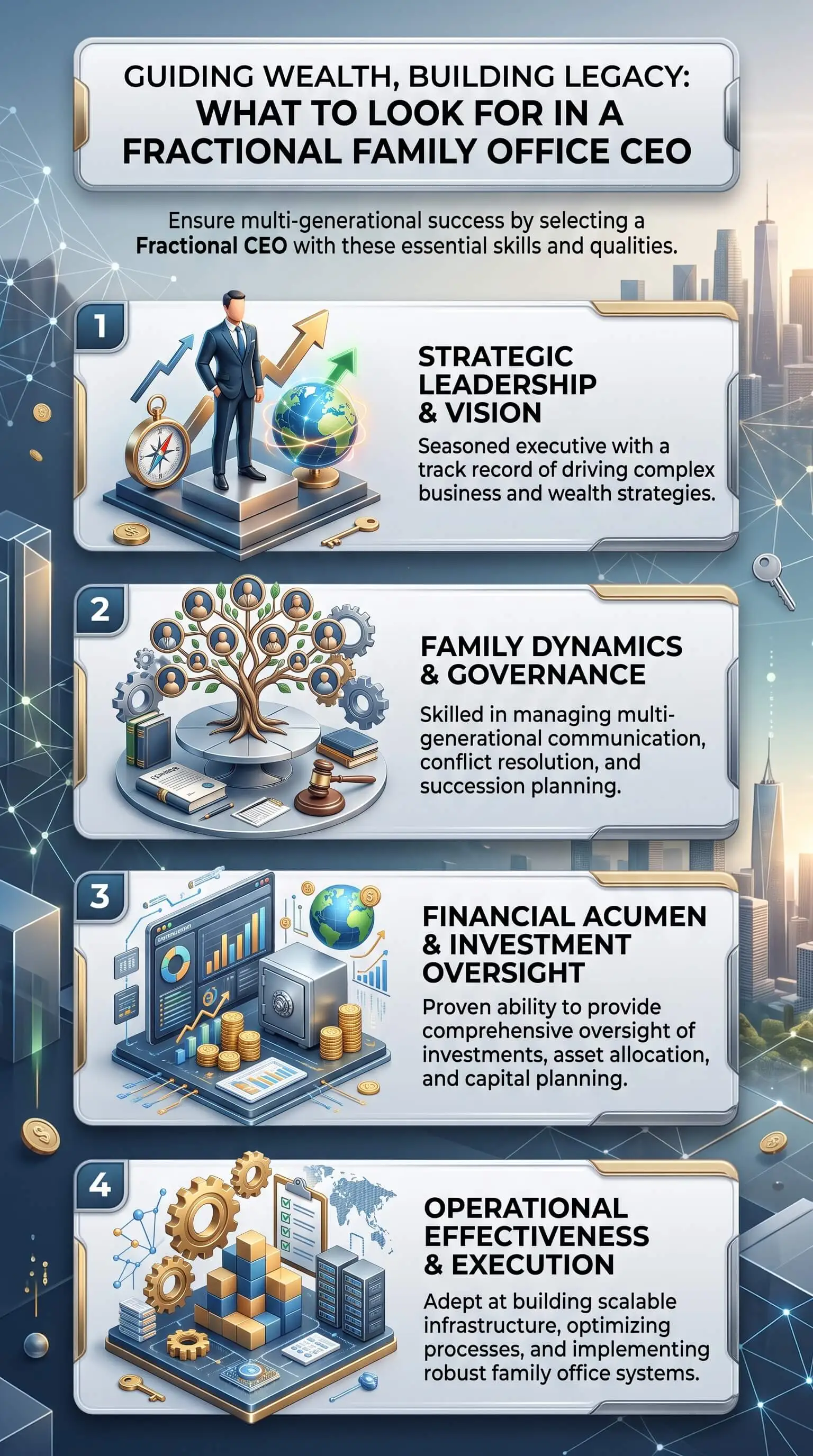
Outsourced family office executive services give a family one senior leader who coordinates its wealth, advisors, and administration, part-time or through a shared multi-family office platform, without the cost of staffing a private office. The family keeps its CPA, attorney, and investment team. The executive keeps them working from one plan.
What the role typically covers:
Single point of accountability: one person who tracks every decision and action item until it's closed
Advisor coordination: shared information and shared priorities across your CPA, estate attorney, insurance professional, and investment team
Reporting and cash flow oversight: one consolidated view across accounts, entities, and trusts
Governance support: family meetings, decision frameworks, and next-generation preparation
Transition support: business sales, succession, and estate updates
What to confirm before hiring:
Fiduciary status and compensation, both in writing
Direct family office experience with families of similar complexity
A written scope that follows an initial assessment of your accounts, entities, and advisors
This role does not provide legal or tax advice. It makes sure the licensed professionals who do give that advice act on the same plan, on time.
Top Takeaways
Pick someone who has worked inside family offices, since corporate leadership alone won't prepare them for trusts and family dynamics.
Expect one point of accountability who keeps a written list and closes every open item.
Get fiduciary status and compensation terms in writing before you sign.
Ask for a sample reporting package and judge whether it would help you make a decision.
Give governance skill real weight, because an unresolved family disagreement can stall a plan for years.
Find out who can see your documents and how that access is controlled.
Insist on an assessment and a written scope before the work starts.
What a Fractional Family Office CEO Actually Does
A family office runs the financial and administrative side of a wealthy family's life, and a traditional single-family office does it with its own staff, payroll, and overhead.
The fractional version gives you the leadership without building the whole office. Your fractional CEO works part-time for your family or serves several families through a shared platform. Your CPA, estate attorney, insurance professional, and investment team keep doing what they do well. The CEO's job is making sure their work connects.
This person doesn't replace your attorney or your CPA, and they don't give legal or tax advice. They organize information, track decisions, and get the right expert moving at the right time.
Business owners will recognize the logic. It's the same thinking behind choosing a good outsourced accounting partner, applied to the family's entire financial picture instead of one company.
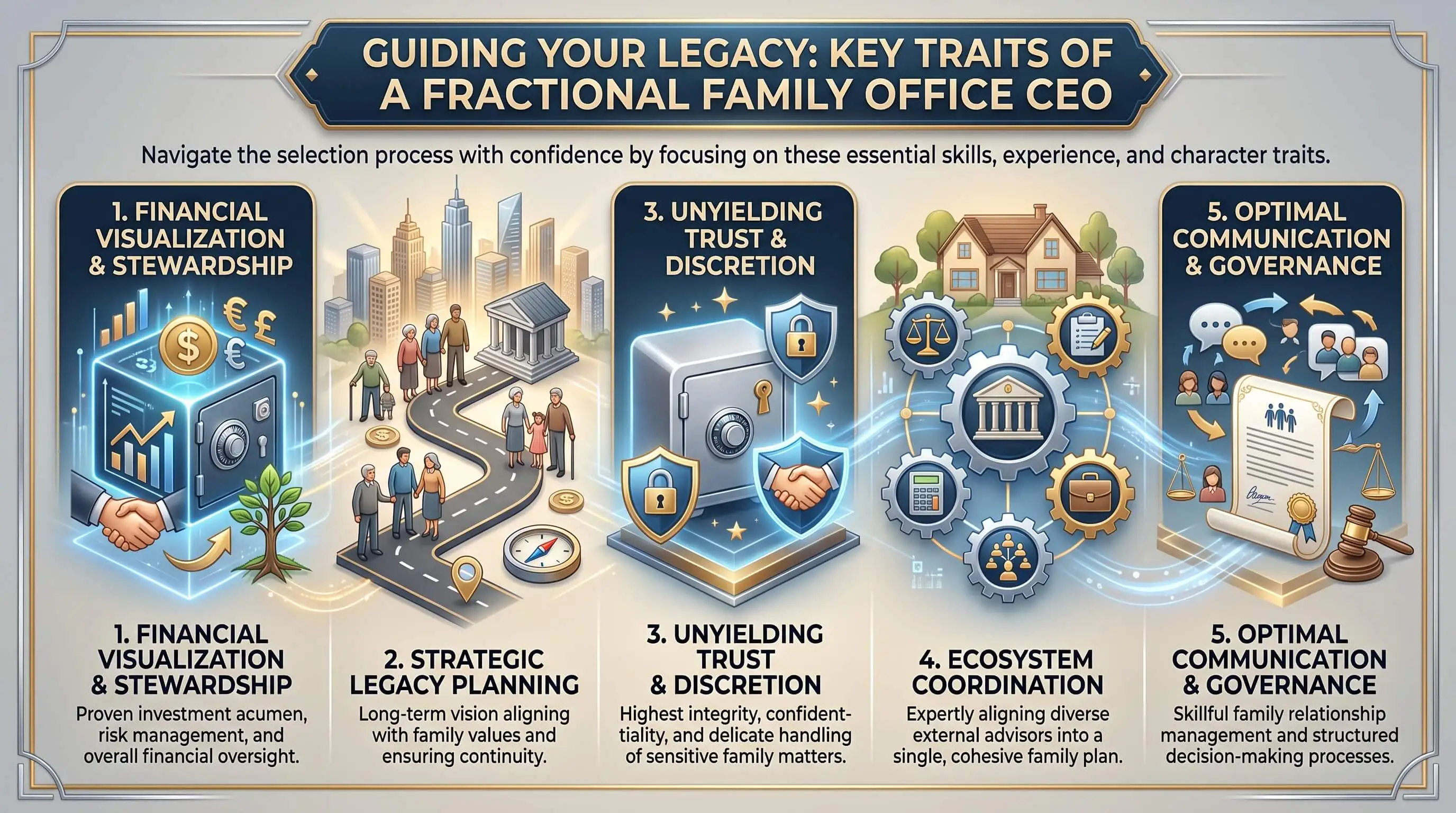
7 Qualities to Look For in a Fractional Family Office CEO
1. Direct Family Office Experience
Running a company teaches plenty, but it won't teach you how a grantor trust interacts with a family limited partnership or how to keep a sibling dispute from stalling a land sale. That knowledge comes from time spent inside family wealth.
Look for someone who has worked in single-family or multi-family offices and has served families that look like yours, whether that means an operating business, farmland, several trusts, or three generations who want different things.
Ask this: How many families do you serve today, and how complex are their situations?
2. A Coordinator's Instincts
What you're really buying is a single point of accountability. Someone tracks every open item, knows who owns it, and follows up until it's closed.
Without that person, planning drifts. The CPA waits on the attorney, the attorney waits on the family, and a gifting deadline passes without anyone noticing. A good coordinator keeps a written action list and runs advisor meetings with an agenda and an owner for every task.
Ask this: Walk me through the last planning cycle you ran across a family's CPA, attorney, and investment team.
3. Fiduciary Duty and Transparent Compensation
You want someone legally and ethically bound to put your family first. Ask whether they act as a fiduciary in every part of the relationship, and get the answer in writing.
Then ask how they're paid. A flat fee, a retainer, and an asset-based fee can all work fine. Commissions on products they recommend are a different matter, and you'll want to understand them before you sign. The SEC's Investment Adviser Public Disclosure site and FINRA BrokerCheck both show registrations, Form ADV filings, and any disciplinary history.
Ask this: Are you a fiduciary at all times with us, and exactly how are you compensated?
4. Financial and Reporting Fluency
When a family holds assets across several entities, somebody has to pull it into one clear view. Your fractional CEO should be comfortable with consolidated reporting, cash flow across accounts, balance sheet oversight, and getting ready for tax season. Much of this overlaps with the Personal CFO role.
Good reporting helps you decide something. A stack of custodial statements doesn't.
Ask this: Can I see a redacted sample of the reporting package a client family receives?
5. Governance and People Judgment
In most families, the people are harder to manage than the money. A strong fractional CEO can run a family meeting, put a simple decision-making framework in place, and help the next generation understand how the family's assets actually work.
That takes patience. It also takes enough confidence to name a disagreement early, before it hardens into something worse.
Ask this: Tell me about a time family members disagreed over a shared asset. What did you do?
6. Discretion and Security Discipline
Your fractional CEO will see tax returns, trust documents, account logins, and private family matters, so their habits around that information should be written down.
Look for documented workflows and permission-based access to a secure document system. Every person should have an individual login, and the firm should be able to tell you exactly who on its team sees what.
Ask this: Who will have access to our documents, and how is that access granted and removed?
7. Transition Experience and a Defined Scope
Families often bring in a fractional leader during a change, such as selling a business, working through succession, or updating an estate plan after a death. Someone who has guided families through liquidity events will spot problems you haven't thought of yet.
Scope matters just as much. A sound engagement opens with an assessment that maps your accounts, entities, advisors, documents, and recurring obligations. The written scope comes out of that map and spells out what's included, what isn't, and how the fee is set.
Ask this: What do the first 90 days look like, and what's in and out of scope?
How a Fractional CEO Compares to Other Family Office Models
Families weighing outsourced family office executive services are really deciding which of three setups fits them best.
Fractional family office CEO: You get senior leadership and coordination for a fraction of full-time cost. Your leader's attention is shared with other families or limited by hours, so the family has to stay engaged and responsive.
Multi-family office: Reporting, workflows, and security are already built, and the leadership role comes with a team of specialists you'd otherwise hire one at a time.
Full-time single-family office executive: Dedicated and on-site, and worth it once a family can carry the full cost of its own office. That cost is substantial, as the statistics below show.
Red Flags to Watch For
A scope that's vague or never written down
Pay tied to selling you financial products
A plan to replace every trusted advisor in the first month
No sample reporting, and no references from families of similar complexity
Hesitation when you ask for fiduciary status in writing
"Most families size up a family office leader in the first meeting, when the better test comes around month six. By then you can see whether the action items actually closed, whether the CPA and the estate attorney finally got on the same call, and whether anyone had to chase anybody. When a family asks me how to compare candidates, I suggest they request a redacted action-item tracker from a current client. It shows how decisions get recorded, who owns each task, and how long things sit before someone follows up. You learn more from that one page than from any pitch deck. I'd also be careful with anyone whose first move is replacing the CPA who has known your family for twenty years. The leaders I trust build on the relationships a family already has."
7 Essential Resources
SEC Investment Adviser Public Disclosure: Search any registered adviser firm or representative and read its Form ADV, which covers services, fees, and disciplinary disclosures.
FINRA BrokerCheck: A free background check on employment history, licenses, customer complaints, and regulatory actions.
CFP Board: Verify a CFP Professional: Tells you whether a candidate currently holds CFP certification and whether the CFP Board has disciplined them publicly.
SEC Family Office Small Entity Compliance Guide: The SEC's plain-language explanation of how Rule 202(a)(11)(G)-1 defines a family office.
IRS: Estate and Gift Taxes: The federal ground rules your family office leader will plan around with your CPA and estate attorney.
Cerulli Associates: $124 Trillion Wealth Transfer Through 2048: The research behind the generational handoff that's pushing many families to put formal leadership in place now.
What Makes a Good Outsourced Accounting Partner for a Growing Business?: Our companion guide to vetting outsourced financial help on the business side.
With these sources, you can confirm a candidate's credentials, understand the rules that shape family offices, and better evaluate outsourced business and financial accounting firms. You'll also walk into every interview with better questions.
3 Statistics
The handoff is already happening. Cerulli Associates projects that $124 trillion in wealth will change hands through 2048, with $105 trillion going to heirs and $18 trillion to charity. About $62 trillion of it is expected to come from high-net-worth and ultra-high-net-worth households, even though they make up roughly 2% of all households. With that much moving between generations, someone needs to own the plan.
Running your own office costs seven figures a year. The RBC and Campden Wealth North America Family Office Report 2025, as cited in Forbes, puts annual single-family office operating costs between roughly $1.1 million and $9.8 million. A fractional leader lets many families get the coordination without taking on that overhead.
Family communication has become standard practice. In Cerulli's 2024 research, 89% of firms surveyed named family meetings and regular communication among family members as a key practice. Governance skill belongs near the top of your list for exactly that reason.
Final Thoughts and Opinion
Put coordination and judgment first when you hire, credentials second, and price last. In my experience, the families who get the most from outsourced family office executive services picked their leader for how reliably things got done, not for the most impressive résumé in the room.
The fractional model has a real trade-off. Your leader's attention is shared, so the arrangement only works when the family stays involved. Someone still has to make the decisions, show up to the quarterly meeting, and answer questions before they sit for weeks. A fractional CEO can organize all of it, but the choices still belong to your family.
Respect the advisors you already have, too. The CPA who has filed your returns for fifteen years carries context that a newcomer can't rebuild, and a good fractional leader treats that history as something to build on.
When the setup works, your family moves from scattered to coordinated. Documents live in one place and deadlines get met, with remote outsourced QuickBooks bookkeeping services helping keep day-to-day financial records organized. The family spends less time chasing details and more time on what the wealth is actually for.
Frequently Asked Questions
What is a fractional family office CEO?
It's a senior leader who oversees a family's wealth, advisors, and administration part-time or through a shared platform. They keep your CPA, attorney, and investment team working from one plan, track decisions, and keep reporting organized. You get that leadership without paying to staff a full single-family office.
How much do outsourced family office executive services cost?
Cost depends on how many entities, accounts, and advisors are involved, how often the family meets, and whether a transition like a business sale is underway. Most arrangements use a flat annual retainer, a project fee for defined work, or an asset-based fee. Ask every candidate for a written scope so you can compare the same work side by side.
What's the difference between a fractional family office CEO and a Personal CFO?
The two roles overlap, and some firms use the titles interchangeably. A Personal CFO usually concentrates on financial oversight, including cash flow, the balance sheet, reporting, and tax readiness. A fractional family office CEO tends to take the wider view and adds governance, advisor coordination, and family decision-making.
Do you need a family office CEO if you already have a CPA and an estate attorney?
Often, yes. Your CPA and attorney are specialists, and each one sees only part of the picture. A family office leader connects their work, makes sure recommendations get carried out, and keeps deadlines from falling through the gaps between them. A good one works alongside the advisors you trust instead of replacing them.
When should a family bring in a fractional family office leader?
The usual triggers are an upcoming business sale, a growing stack of trusts and entities, a generational transition, or the moment someone admits they've been the family's unpaid coordinator for years. Once keeping everything aligned feels like a second job, start talking with candidates.
How do I verify a family office executive's credentials?
Look up the firm and the individual on the SEC's Investment Adviser Public Disclosure site and on FINRA BrokerCheck to check registration and disciplinary history. If they list CFP certification, confirm it with the CFP Board's verification tool. If an educational consultant is part of the broader family advisory team, verify their credentials as well. After that, ask for references from families with similar complexity and call them yourself.
Find the Leader Who Fits Your Family's Next Chapter
A short list and the right questions will get you further than weeks of reading firm websites.
Write down what you have today, including accounts, entities, trusts, advisors, and recurring deadlines.
Decide how much support you need, anywhere from financial oversight alone to full coordination and governance.
Shortlist three candidates who already serve families as complex as yours.
Check each one's public record, then bring the seven "Ask this" questions to your first meeting.
Lay the answers side by side and choose the person who gives your family the clearest picture. If you have a question about choosing a family office leader, leave it in the comments below. And if someone in your family has been carrying the coordination alone, send this their way.