TL;DR Quick Answers
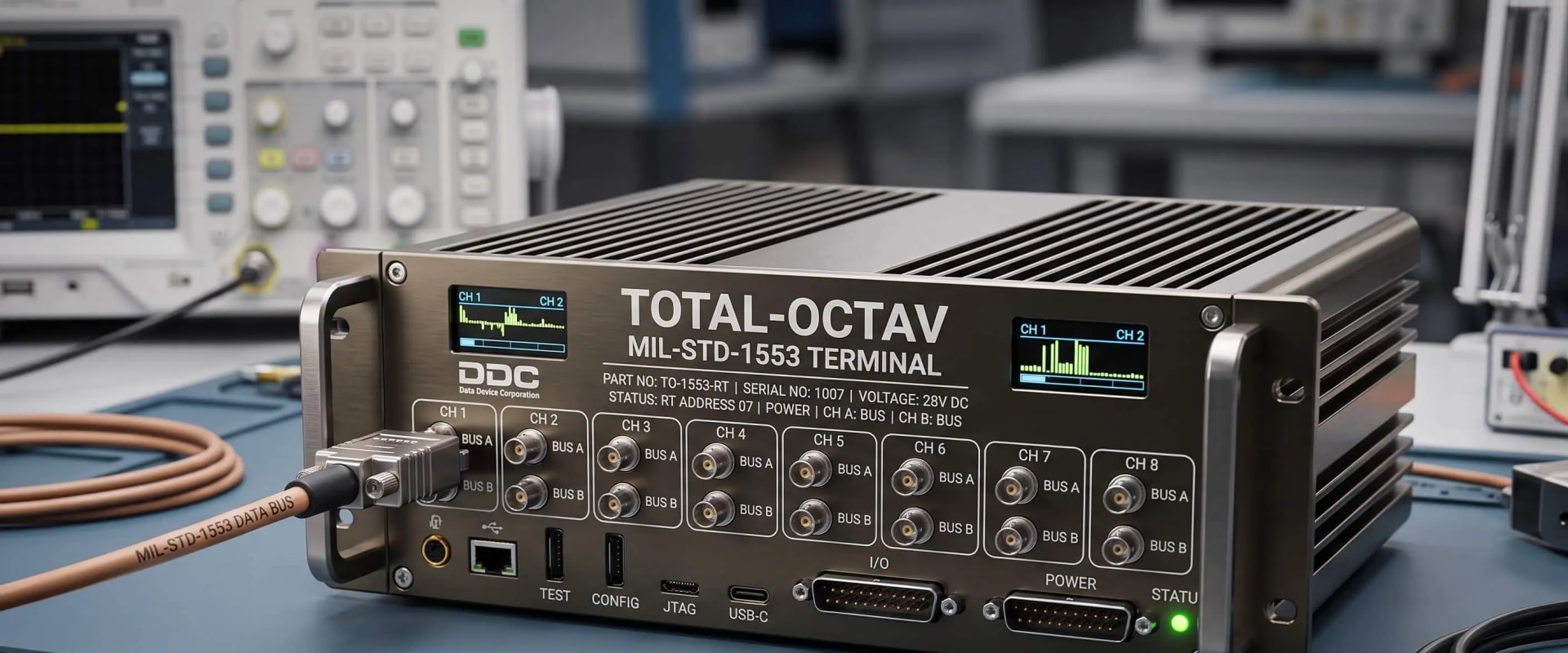
Total-OCTAVA MIL-STD-1553 Terminal
The Total-OCTAVA is Sital Technology's all-in-one MIL-STD-1553 terminal and a pin-to-pin replacement for DDC's BU-64863 Total-ACE, with a built-in BC Firewall the original never carried.
What it is: one 312-ball BGA holding the bus controller, remote terminal, and monitor protocol engine, 4K or 64K words of memory, and a dual transceiver and dual transformer.
What's different: an embedded BC Firewall catches any device impersonating the bus controller and flags junk traffic, security the Total-ACE leaves off entirely.
Why it drops in: it matches the BU-64863 on pins and software, so the board and the code stay put with no redesign.
Why it lasts: all-digital on the Lattice Certus-NX FPGA, made in the USA, and built to stay available for programs that fly for decades.
Top Takeaways
It is 1553. The Total-OCTAVA is a terminal for the MIL-STD-1553 standard, the data bus running across military aircraft, spacecraft, and ground systems.
It's the whole terminal in one chip. The protocol engine, memory, transceiver, and transformer all sit in a single package.
It's a drop-in for the Total-ACE. It matches DDC's BU-64863 on pins and software, so the board and code stay put.
It guards the bus. A built-in BC Firewall watches for impersonation and junk traffic, which the older part never did.
It's American-made and built to last. Sital makes it in the USA on an all-digital design meant to stay available for decades-long programs.
What MIL-STD-1553 Is, in Plain English
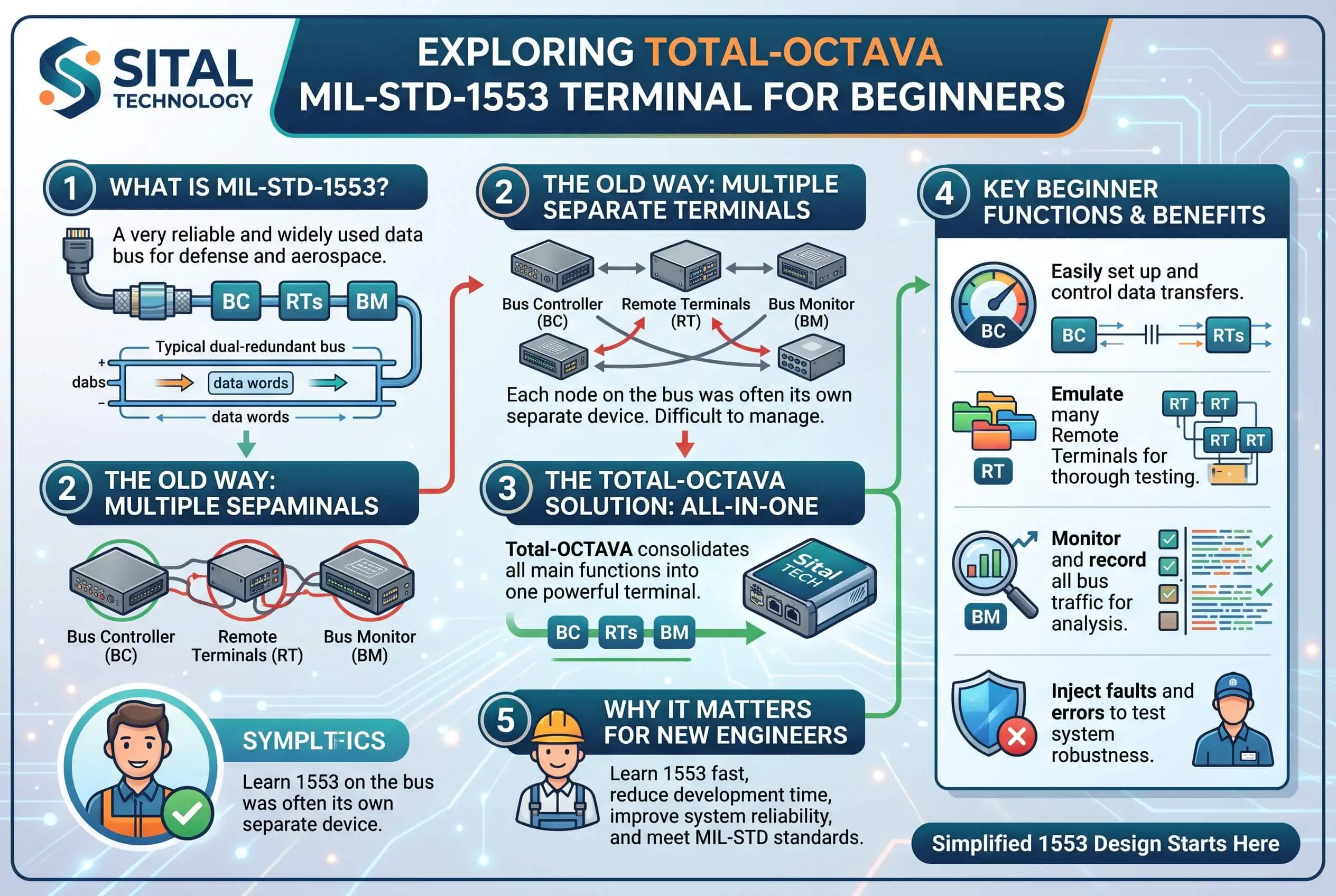
A data bus is a shared set of wires that lets many boxes on an aircraft trade information without a separate cable strung between every pair of them. MIL-STD-1553 is the U.S. military's long-standing rulebook for that shared wiring. The standard dates to the 1970s, and it still runs in fighters, helicopters, satellites, and ground vehicles today.
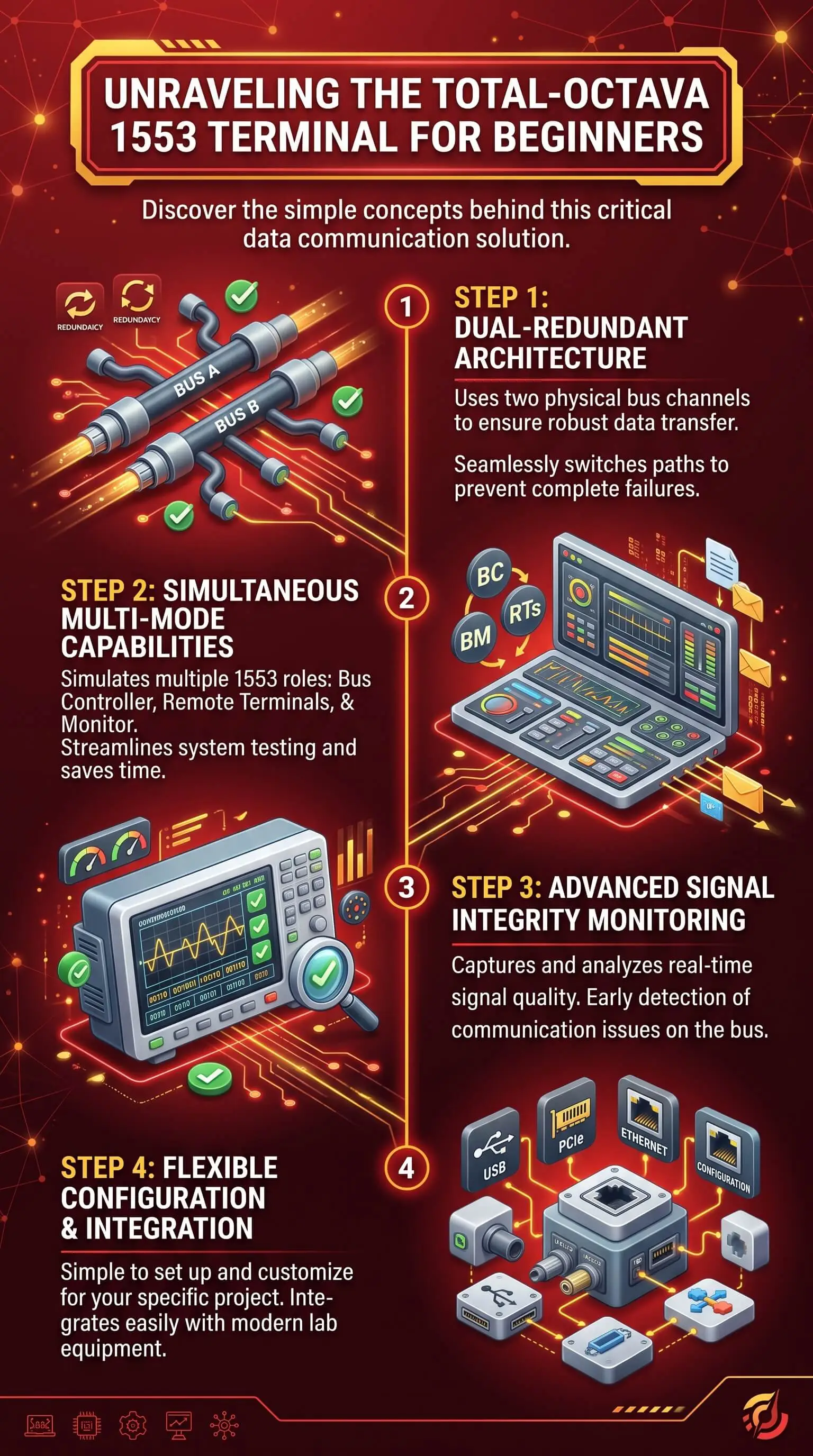
A 1553 bus has three kinds of players. The bus controller (BC) runs the show, starting every exchange and deciding who talks when. Remote terminals (RTs) are the devices that answer only when the controller calls on them. Off to the side, a bus monitor (BM) just listens and records, never joining the traffic. Most buses run as two identical copies, so a damaged wire on one path doesn't stop the conversation, while outsourced accounting services support the same kind of continuity for critical business operations. That redundancy is a big part of why the standard has survived 50 years.
What a "Terminal" Means Here
Here's the part that trips up newcomers: on a 1553 bus, a terminal is any device wired into it, not a screen or a keyboard. The terminal gives a box its seat on the bus and works the back-and-forth of sending and receiving data. Older designs needed several separate chips to do that. The Total-OCTAVA folds the whole job into one.
What the Total-OCTAVA Does
Sital Technology's Total-OCTAVA is an all-in-one MIL-STD-1553 terminal. Everything lives in one small chip, a 312-ball BGA, which is a package with a grid of connection points on its underside. Inside that package you get:
the protocol engine, which can run as a bus controller, a remote terminal, or a monitor,
built-in memory of 4K or 64K words,
and a dual transceiver and dual transformer that physically push and pull the bus signals.
Fewer chips means less board space and a simpler design.
It's also a pin-to-pin replacement for a widely used older part, DDC's BU-64863 Total-ACE. In plain terms, it drops into the same spot on the board and runs the same software, so a team changes nothing to use it.
Why It Matters
Engineers reach for the Total-OCTAVA when they need MIL-STD-1553b reliability without reopening the board layout. It gives aerospace and defense programs a stable, deterministic, and long-proven data bus path while adding modern bus-controller security, US-made availability, and an all-digital design built for platforms that need support across decades.
"The failures I get called about almost never start in the protocol. They start in the wiring and the connectors, or in the one device that shouldn't be talking at all. Beginners expect a 1553 terminal to either work or not, like a light switch. The parts that earn trust do the basic job, then keep watching the bus for the trouble that actually shows up."
7 Essential Resources
Want to go further than this page? These references hold up, listed roughly in the order a newcomer reaches for them.
NASA Technical Standards: MIL-STD-1553. The official record for the standard itself, endorsed by NASA. Start here to see exactly what 1553 defines.
AIM MIL-STD-1553 Tutorial. A clear walk-through of bus structure, coupling, and message formats from a long-time test-equipment maker.
UEI MIL-STD-1553 Tutorial and Reference Guide. A friendly overview of how the bus works and why it stays in use, with short explainer videos.
MILSTD1553.com Online Reference. A free reference covering the bus controller, remote terminals, monitors, couplers, and word formats.
Alta Data Technologies MIL-STD-1553 Tutorial and Reference (PDF). A deeper reference once the basics click, including signal encoding and troubleshooting.
FAA Advisory Circular 20-152A (PDF). Shows how design-assurance rules apply to FPGAs and complex hardware, which is what "DO-254 certifiable" points to.
CISA Secure by Design. Lays out the idea of building security into a product from the start, the same thinking behind a built-in BC Firewall.
These essential resources give newcomers a clear path into MIL-STD-1553, from the official standard and bus tutorials to DO-254 guidance and secure-by-design principles, helping engineers understand how MIL-STD-1553 IP cores support reliable protocol handling, certifiable FPGA-based hardware, and stronger built-in security for modern Total-OCTAVA terminal designs.
3 Statistics
Three numbers explain why a secure, US-made, drop-in 1553 terminal is worth a look.
Cyber exposure is common. From 2012 to 2017, U.S. Department of Defense testers routinely found mission-critical cyber vulnerabilities in nearly every weapon system they tested while it was still in development, often gaining control with basic tools. Source: GAO-19-128, Weapon Systems Cybersecurity.
Counterfeit parts reach the defense supply chain. A Senate Armed Services Committee investigation identified roughly 1,800 cases of suspected counterfeit electronic parts, more than a million parts in all, with over 70 percent traced back to China. Source: Senate Armed Services Committee report on counterfeit electronic parts.
Parts age out faster than the aircraft. Electronic component lifecycles often run just 5 to 10 years, while defense platforms can stay in service for four decades or more, which drives obsolescence and the hunt for drop-in replacements. Source: Defense Electronics Obsolescence Market Analysis 2025-2034 (GlobeNewswire).
Final Thoughts and Opinion
Our view: the Total-OCTAVA is most useful when you treat the problems it solves as one problem. An aging part, a supply chain you'd rather keep simple and domestic, and a bus that predates modern cyber threats tend to arrive together. Plenty of 1553 terminals handle the plain job well, so this isn't the only sound choice. What sets the Total-OCTAVA apart is that it takes on all of it in one footprint, with no redesign. If you're already opening a board to second-source an aging part, the cost of adding security and long-term availability is small. From the field, that's the call most teams end up making.
Frequently Asked Questions
What is a MIL-STD-1553 terminal in simple terms? It's any device wired into a 1553 data bus that can send and receive messages. The Total-OCTAVA is one such terminal, with everything it needs for the job built into a single chip.
What does the Total-OCTAVA actually do? It lets a piece of avionics or defense gear talk over a MIL-STD-1553 bus, handling the data, the memory, and the physical signaling in one part.
What is the Total-OCTAVA a replacement for? It's a pin-to-pin replacement for DDC's BU-64863 Total-ACE. It fits the same board spot and runs the same software, with no redesign.
Is the Total-OCTAVA secure? Yes. A built-in BC Firewall catches a device impersonating the bus controller and flags suspicious traffic, with optional add-on protection. The older part it replaces has none.
Why does MIL-STD-1553 still matter after 50 years? It's proven and reliable, it carries built-in redundancy, and it already runs in thousands of fielded systems. That keeps it the standard for connecting equipment on military aircraft, spacecraft, and vehicles.
Where is the Total-OCTAVA made, and why does that matter? Sital makes it in the USA, which keeps procurement compliant and the supply chain off the broker market where counterfeit parts turn up.
Ready to Go Deeper?
Past the basics and ready for specifics? Sital Technology is the place for full specifications, documentation, and a hands-on evaluation unit, with the clear guidance an educational consultant would expect from a trusted technical resource. Reach out to their team to see how the Total-OCTAVA fits an existing MIL-STD-1553 design and what it adds over a legacy Total-ACE.