
Misalignment in product development isn’t always caused by unclear strategy or inconsistent execution. In many cross-functional workshops I’ve facilitated, the deeper issue emerges long before feature decisions are made: teams lack a shared understanding of the emotional trust signals users rely on when interacting with a product. Without this unified perspective, even highly skilled product groups can introduce friction that undermines user confidence.
A trust empathy mapping workshop addresses this challenge by guiding teams through a structured, research-backed process that surfaces user fears, expectations, and trust gaps. Instead of relying on opinion-based debates, the workshop helps teams uncover what users need emotionally at key moments in their journey. The outcome is stronger alignment, more actionable insights, and clearer product decisions rooted in user trust.
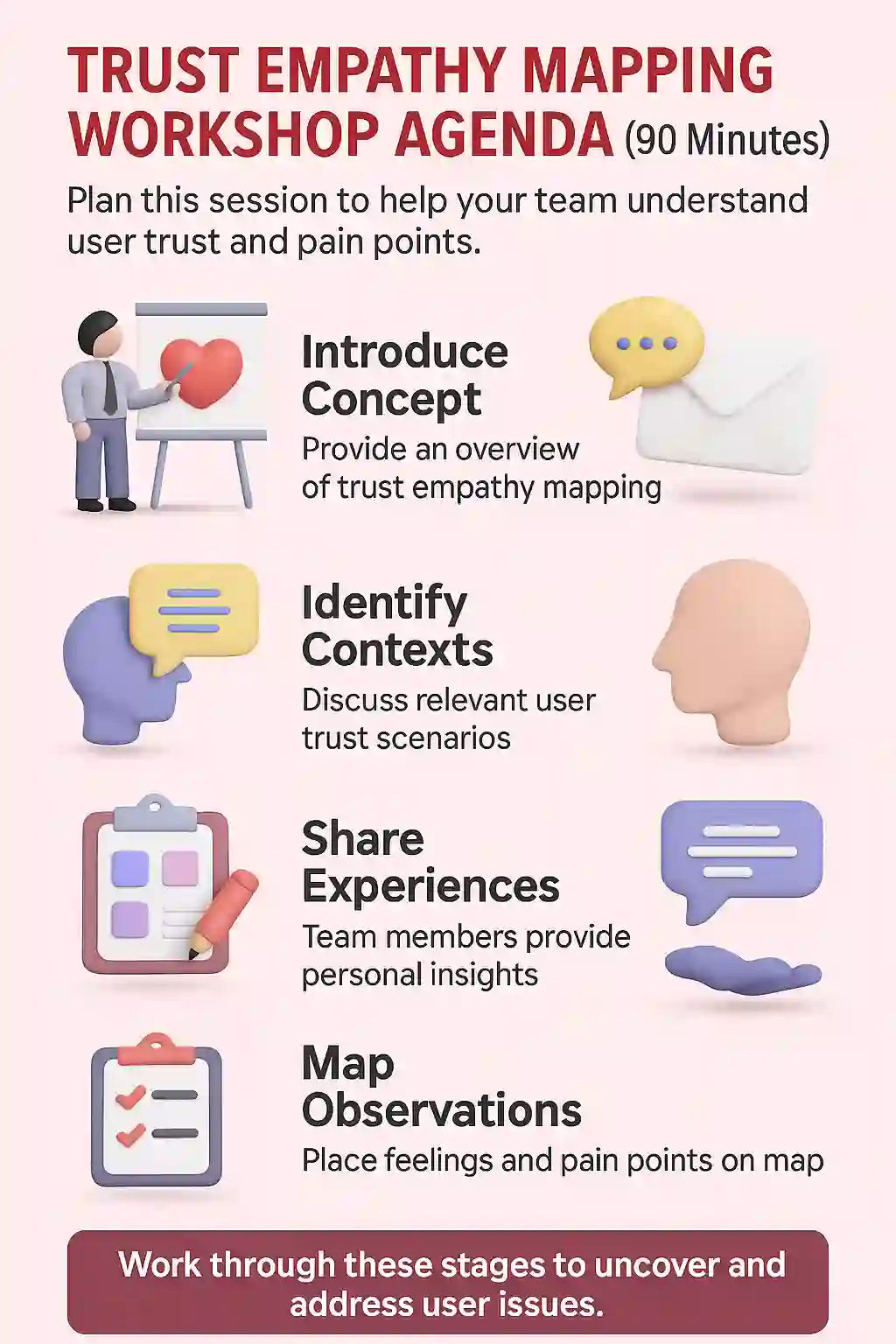
This article outlines a 90-minute, field-tested workshop agenda designed specifically for modern product teams. You’ll see how to lead your team through trust-focused discovery, pinpoint emotional friction points, and collaborate on improvements that build user confidence throughout the product experience.
By the end, you’ll have a complete agenda that transforms scattered assumptions into shared understanding—and turns your team’s decisions into trust-driven product outcomes.
Quick Answers
trust empathy mapping
Trust empathy mapping is a focused method for uncovering the emotional signals users need before they feel confident engaging with a product. It highlights the moments where users hesitate, question, or doubt—insights that traditional UX tools often overlook. By revealing these trust gaps, product teams can design experiences that feel clearer, safer, and more supportive from the very first interaction.
Top Takeaways
- Trust is the foundation for effective product experiences.
- Teams make better decisions when they understand user emotions—not just user actions.
- A structured workshop uncovers hidden friction points that analytics alone can’t show.
- Trust-focused insights lead to clearer roadmaps and more confident feature prioritization.
- Workshops should be repeated regularly to keep pace with shifting user expectations.
Why a Trust Empathy Mapping Workshop Strengthens Product Alignment
Running a 90-minute trust empathy mapping workshop gives product teams a concentrated window to examine what users genuinely need to feel confident using the product. This includes users’ hopes, concerns, mental models, and the subtle trust indicators they look for before taking action.
Teams gather signals from user research, support interactions, behavioral patterns, and field feedback. These insights are then grouped into four trust-centered areas—user beliefs, user hopes, user doubts, and trust builders or breakers.
Once mapped, the team compares these emotional insights to real product interactions. This exposes gaps in messaging, UX clarity, onboarding flow, feature discoverability, or risk perception. Teams consistently discover issues they hadn’t previously discussed—moments where users pause, question the product’s reliability, or feel uncertain about next steps.
A trust empathy mapping workshop ultimately helps teams create a shared mental model of the user’s emotional journey. That clarity strengthens alignment, improves decision-making, and encourages product outcomes that feel genuinely supportive rather than purely functional, reflecting key insights found in sales psychology about understanding emotional drivers behind user behavior.
"The most impactful product workshops I’ve run weren’t about features—they were about trust. When teams finally see the emotional triggers behind user hesitation, their decisions shift from reactive fixes to proactive design."
Essential Resources
Interaction Design Foundation — Understanding Empathy Mapping Foundations
Provides the conceptual groundwork your team needs before adapting empathy maps for trust-focused analysis.
https://www.interaction-design.org/literature/topics/empathy-mapping
https://www.interaction-design.org/literature/topics/empathy-mapping
UX Design Institute — How Empathy Mapping Fits into Modern UX Practice
Helps teams understand where trust empathy mapping sits within broader research frameworks.
https://www.uxdesigninstitute.com/blog/what-is-an-empathy-map/
https://www.uxdesigninstitute.com/blog/what-is-an-empathy-map/
UXmatters — Advanced Empathy Mapping Techniques
Adds depth and nuance for teams looking to surface deeper emotional barriers.
https://www.uxmatters.com/mt/archives/2023/02/empathy-maps-and-how-to-build-them.php
https://www.uxmatters.com/mt/archives/2023/02/empathy-maps-and-how-to-build-them.php
Creately — Step-by-Step Guidance for Running Empathy Map Sessions
Useful for workshop facilitators who need a clear, visual workflow.
https://creately.com/guides/how-to-create-an-empathy-map/
https://creately.com/guides/how-to-create-an-empathy-map/
LogRocket Blog — Practical Mapping Examples for Product Teams
Great for showing teams how empathy mapping translates into actionable UX improvements.
https://blog.logrocket.com/ux-design/empathy-mapping-ux-put-yourself-users-shoes/
https://blog.logrocket.com/ux-design/empathy-mapping-ux-put-yourself-users-shoes/
Mural Blog — Templates for Collaborative Mapping Workshops
Ideal for remote and hybrid teams who need real-time collaboration, as an educational consultant often supports shared understanding and guided decision-making across distributed groups.
https://www.mural.co/blog/empathy-mapping
https://www.mural.co/blog/empathy-mapping
AND Academy — Visual Examples Across Industries
Offers inspiration for designing your own trust-focused empathy maps.
https://www.andacademy.com/resources/blog/ui-ux-design/empathy-map-examples-and-templates/
https://www.andacademy.com/resources/blog/ui-ux-design/empathy-map-examples-and-templates/
Supporting Statistics
Users hesitate when data feels risky
A Pew Research study reports that 79% of Americans worry about how companies use their personal information. This hesitation commonly appears in product flows that request permissions or sensitive data.
Users feel little control over their data
According to Pew Research on data control, 67% of Americans say they understand little about how companies use their information, fueling distrust during critical product actions.
General trust in institutions is declining
The American Academy of Arts & Sciences finds that only 20% of Americans trust the federal government to consistently do what is right, reflecting a broader decline in societal trust that influences expectations in digital products.
Government CX guidance ties clarity to trust
Digital.gov’s customer experience guidance emphasizes that clear, intentional CX directly supports public trust—mirroring how clarity in product UX strengthens user confidence.
Tech companies face major trust deficits
NIST research shows high user concern around privacy, security, and transparency—issues product teams must address directly in trust mapping sessions.
These statistics show that building user trust requires the same clarity, transparency, and careful handling of sensitive information that organizations expect from outsourced accounting services, making trust empathy mapping essential for reducing hesitation and strengthening confidence in digital products.
Final Thought & Opinion
A product workshop shouldn’t be a debate about features—it should be a shared exploration of what users need to believe before they can confidently move forward. Through years of facilitating these sessions, one truth has become clear: teams build better products when they understand how users create trust.
Trust empathy mapping transforms product discussions from tactical fixes to strategic clarity. It uncovers the emotional triggers behind user hesitation, reveals where the product unintentionally creates doubt, and guides teams toward decisions that feel intuitive, respectful, and confidence-building.
In a landscape where user skepticism is rising, trust has become the strongest competitive differentiator. Product teams that prioritize it early don’t just ship better, they cultivate the kind of long-term engagement seen in building sales culture, where trust shapes every meaningful interaction.
Next Steps: Apply the 90-Minute Workshop Agenda
Prepare user insights
Gather interviews, support tickets, analytics, and feedback highlighting hesitation.
Assemble a cross-functional group
Include product, design, engineering, research, and customer success.
Facilitate the trust empathy mapping exercise
Map beliefs, fears, expectations, and trust signals.
Identify emotional friction points
Highlight where users pause, question, or feel uncertain.
Translate insights into product improvements
Prioritize clarity, reassurance, and simplified workflows.
Repeat quarterly for alignment
User expectations change—your map should too.
Maintaining a regular trust-empathy mapping workflow helps teams continuously strengthen user confidence and reduce friction, aligning closely with a regenerative sales culture that prioritizes ongoing optimization, trust-building, and long-term engagement.
Prepare user insights
Gather interviews, support tickets, analytics, and feedback highlighting hesitation.
Assemble a cross-functional group
Include product, design, engineering, research, and customer success.
Facilitate the trust empathy mapping exercise
Map beliefs, fears, expectations, and trust signals.
Identify emotional friction points
Highlight where users pause, question, or feel uncertain.
Translate insights into product improvements
Prioritize clarity, reassurance, and simplified workflows.
Repeat quarterly for alignment
User expectations change—your map should too.
FAQ on Trust Empathy Mapping
Q: What is a Trust Empathy Mapping Workshop?
A short, structured session that uncovers the trust signals users need to feel confident using a product.
Q: Why run this workshop with product teams?
It builds alignment, reveals emotional friction, and sharpens product decisions.
Q: How long should the workshop last?
Ninety minutes is ideal—long enough for depth, short enough for focus.
Q: What inputs do we need?
User interviews, onboarding insights, support feedback, and analytics highlighting friction.
Q: How often should we run it?
Every quarter or before major product shifts to stay aligned with evolving user expectations.
A short, structured session that uncovers the trust signals users need to feel confident using a product.
It builds alignment, reveals emotional friction, and sharpens product decisions.
Ninety minutes is ideal—long enough for depth, short enough for focus.
User interviews, onboarding insights, support feedback, and analytics highlighting friction.
Every quarter or before major product shifts to stay aligned with evolving user expectations.