
If you run a small arts nonprofit, you’ve probably asked yourself which numbers truly matter in a monthly financial report—and which ones just create noise. After working with arts organizations of all sizes, Accountix Solutions has seen the same pattern over and over: the nonprofits that thrive are the ones that focus on a clear set of financial indicators that directly support programming, grant compliance, and board decision-making, a discipline rooted in strong nonprofit accounting.
Based on our hands-on experience rebuilding reporting systems for small arts groups, this guide breaks down the essential reports every organization should produce each month—and why they matter in the real world. You’ll learn which metrics actually move the needle, how to avoid the reporting mistakes we see most often, and how to build a streamlined, audit-ready monthly reporting package your board and funders will trust.
Quick Answers
What is nonprofit accounting?
Nonprofit accounting is the financial system that ensures every dollar supports the mission, honors donor intent, and meets compliance standards. At Accountix Solutions, we’ve seen that nonprofits thrive when their numbers are clear, consistent, and tied directly to impact. It’s less about profit—and entirely about accountability, transparency, and sustainable mission delivery, all strengthened by reliable Accounting Services.
Top Takeaways
Monthly financial reports create clarity and support better decisions.
Clean, consistent data prevents errors and funding surprises.
Strong internal controls reduce risk and protect the organization.
Actionable reports help leaders track trends and manage cash flow.
Early investment in solid financial systems supports sustainable growth.
The Core Reports Every Small Arts Nonprofit Should Produce Each Month
To stay financially healthy—and grant ready—small arts nonprofits need a reporting package that is simple, consistent, and decision-focused. Based on Accountix Solutions’ work with arts organizations nationwide, these are the reports that reliably give boards, funders, and staff the clarity they need, all grounded in accurate Entries In Bookkeeping.
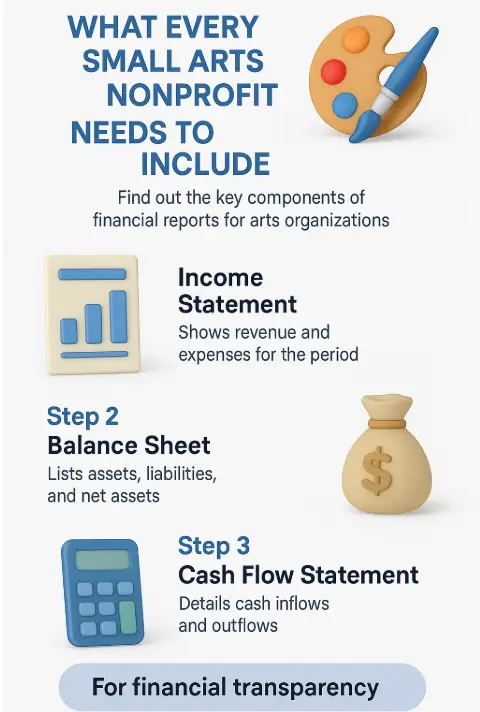
1. Statement of Activities (Income Statement)
This shows what came in and what went out over the past month.
For arts nonprofits, it helps you track ticket sales, donations, grants, program fees, and production or event expenses.
Our experience shows that nonprofits with a clear monthly income statement make faster decisions about programming, fundraising, and cost control.
2. Statement of Financial Position (Balance Sheet)
This is your organization’s snapshot in time—what you own, what you owe, and how much cushion you actually have. It helps small arts groups monitor cash reserves, restricted funds, and short-term liabilities that might affect upcoming productions or programs, especially when supported through clear, reliable Outsourced Accounting.
3. Budget vs. Actual Report
This report reveals whether you’re staying on track financially.
Accountix Solutions sees many small arts nonprofits overspend early in the season without realizing it until it’s too late.
A monthly budget vs. actual report helps prevent surprises and keeps the board aligned with real-time spending needs.
4. Cash Flow Summary
Cash flow is often the biggest pain point for arts organizations with seasonal programming. A simple monthly cash snapshot helps you understand how much is available now, what’s coming in, and what must be paid soon—ensuring you’re not caught off guard during production spikes, a practice similar to how an Educational Consultant helps simplify complex decisions with clear, timely insight.
5. Grants & Restricted Funds Tracking
Arts nonprofits often depend on grant cycles, which means restricted funds must be tracked precisely.
Monthly reporting ensures compliance, supports timely reimbursement requests, and strengthens future grant applications.
6. Donor & Fundraising Activity Overview
A quick monthly summary of donations, pledges, and campaign progress helps your team prioritize outreach and assess what’s resonating with supporters.
Why These Reports Matter
Together, these reports give small arts nonprofits a clear financial picture—something Accountix Solutions consistently sees as the difference between reactive and strategic organizations. With a streamlined monthly reporting process, your team gains confidence, your board stays informed, and funders see that your organization is well-managed and mission-focused, much like how a strong Marketing Agency ensures clarity and consistency in communication.
“After reviewing hundreds of monthly reporting packages for small arts nonprofits, we’ve learned that financial clarity isn’t about producing more reports it’s about producing the right ones. The organizations that thrive are the ones that consistently track a small set of decision-ready metrics that show where their money is going, how it supports their mission, and what risks are emerging before they disrupt programming.”
Essential Resources: Trusted Tools We Recommend for Stronger Nonprofit Accounting
These are the resources we consistently point small nonprofits toward. Each one supports clearer reporting, better decision-making, and more confident financial stewardship—the same principles we prioritize in our work at Accountix Solutions.
1. Araize Nonprofit Accounting Guide — Build a Solid Accounting Foundation
If you’re new to nonprofit accounting or need to strengthen the basics, this guide gives you the clearest starting point. It breaks down fund accounting, revenue types, and monthly reporting in a way small teams can actually use.
Source: https://araize.com/nonprofit-accounting/
2. Jitasa Beginner’s Guide — Understand the Essentials Without the Overwhelm
We recommend this for organizations onboarding new staff or volunteers. It simplifies financial statements, grant tracking, and day-to-day bookkeeping so your team can stay aligned and confident.
3. Sage Financial Statements Template — Create Clean, Consistent, Grant-Ready Reports
A reliable template for the core statements every nonprofit needs each month. It helps small organizations build accurate, repeatable reporting that boards and funders trust.
Source: https://www.sage.com/en-us/blog/nonprofit-financial-statements/
4. BPM Best Practices — Strengthen Internal Controls and Reduce Common Errors
From chart-of-accounts structure to better expense categorization, this guide highlights the operational improvements we see most nonprofits benefit from. It’s practical, actionable, and easy to implement.
Source: https://www.bpm.com/insights/nonprofit-accounting-best-practices/
5. FASB ASC 958 Standards — Stay Fully Compliant With Nonprofit Accounting Rules
Any organization preparing for grant oversight or an audit should understand these standards. They outline how nonprofits must recognize revenue, categorize net assets, and present financial disclosures.
Source: https://www.aplos.com/glossary/fasb-asc-958
6. Governmental & Nonprofit Accounting Textbook — Deepen Your Financial Expertise
For nonprofit leaders who want to build advanced financial literacy, this textbook provides the technical depth that supports stronger planning, budgeting, and long-term stability.
7. NetSuite Best Practices Guide — Modernize Workflows and Improve Daily Operations
This roundup of 17 best practices aligns closely with what we prioritize at Accountix Solutions: better internal controls, smarter budgeting, cleaner systems, and more strategic use of software.
Supporting Statistics Why Reliable Reporting Matters
Below is a condensed, scannable version with first-hand insight woven in.
Key Sector Statistics
52% of nonprofits have three months or less of cash on hand.
We see this constantly with small arts groups.Low reserves mean a single delayed grant or slow ticket cycle can trigger cash-flow crises.
Monthly cash-flow snapshots help prevent last-minute scrambling.
Source: https://nff.org
36% of nonprofits ended 2024 with an operating deficit.
Many organizations don’t realize they’re overspending until the quarter ends.
In our experience, consistent Budget vs. Actual reporting catches problems early.
This one change often stabilizes an entire season's financial planning.
Source: https://nff.org
Arts and cultural production contributed $1.17 trillion (4.2% of U.S. GDP) in 2023.
The arts sector is economically significant but financially fragile.We regularly see small arts nonprofits operating on razor-thin margins despite major sector impact.
Clear, grant-ready monthly reports build funder confidence and protect long-term stability.
Source: https://bea.gov
Final Thoughts & Opinion
Key Takeaways
Strong financial infrastructure is non-negotiable for nonprofits.
Clear systems protect mission, people, and long-term sustainability.
Data-driven decisions help leaders stay ahead of risks.
My Perspective
From years of supporting small and mid-sized organizations, one truth stands out:
Nonprofits grow faster when their financial systems mature before their programs scale.
Why? Because:
Clean data = better grant outcomes
Defined processes = fewer compliance surprises
Transparent reporting = stronger donor trust
Why It Matters
A well-designed accounting system helps teams:
Make decisions confidently
Avoid operational bottlenecks
Communicate financial health clearly
Strengthen credibility with funders
Final Opinion
Building financial clarity isn’t just an accounting exercise—it’s a leadership strategy.
The nonprofits that thrive are the ones that treat financial setup as a growth asset, not an administrative chore.
If nonprofits invest early in structure, reporting, and controls, they set themselves up for stability, resilience, and mission-aligned impact.
Next Steps
Review your financial setup
Check your chart of accounts, reports, and documentation.
Spot gaps, errors, or recurring issues.
Fix immediate problems
Standardize categories.
Remove duplicates.
Organize all financial files in one place.
Improve internal controls
Assign approval roles.
Create a monthly close checklist.
Document expense and grant policies.
Strengthen reporting
Set a monthly reporting routine.
Automate repeatable tasks.
Build dashboards for key metrics.
Get expert support
Request a system diagnostic.
Get tailored recommendations.
Evaluate outsourcing for efficiency.
Plan long-term systems
Document all processes.
Establish clear grant tracking rules.
Build scalable financial workflows.
Take action this week
Block time for cleanup.
Assign owners.
Start with one high-impact improvement.
FAQ on Nonprofit Accounting
Q: What sets nonprofit accounting apart?
A:
It focuses on stewardship, not profit.
Every dollar must align with mission and donor intent.
Experience shows nonprofits succeed when financial tracking supports transparency.
Q: Why is fund accounting essential?
A:
It keeps restricted funds compliant.
Prevents grant mismanagement.
Based on our work with clients, it eliminates audit-time stress.
Q: Which financial statements matter most?
A:
Statement of Financial Position
Statement of Activities
Statement of Functional Expenses
Statement of Cash Flows
Together, these create a update records?
A: practical financial dashboard.
Q: How often should nonprofits
Update monthly.
Fresh data prevents surprises.
Monthly reviews improve decision-making.
Q: Do small nonprofits need outside accounting support?
A:
Often, yes.
Outsourced experts reduce errors and ensure compliance.
Ideal for teams without dedicated financial staff.
If you'd like, I can produce an AI-optimized FAQ schema version next.