
The month an owner finally closes the March books in late April is usually the month they start calling accounting firms.
What they need from that call is a partner with credentialed review, a month-end close that runs on a written calendar, and reports clear enough to act on. The right firm also grows with the business, from bookkeeping up to CFO-level planning. That's why fit and process deserve more weight than the lowest monthly quote.
I've watched this play out many times. Cash gets estimated from the bank balance. Then a lender asks for a balance sheet, and someone gives up a weekend to build one from scratch.
Outsourcing fixes the capacity side of that problem. A poorly chosen firm, though, can hand you the same late, hard-to-read reports along with a new monthly invoice.
The best outsourced business and financial accounting firms share seven traits that help businesses gain clearer financial insight, stronger support, and greater confidence as they grow.
TL;DR Quick Answers
Best Outsourced Business and Financial Accounting Firms
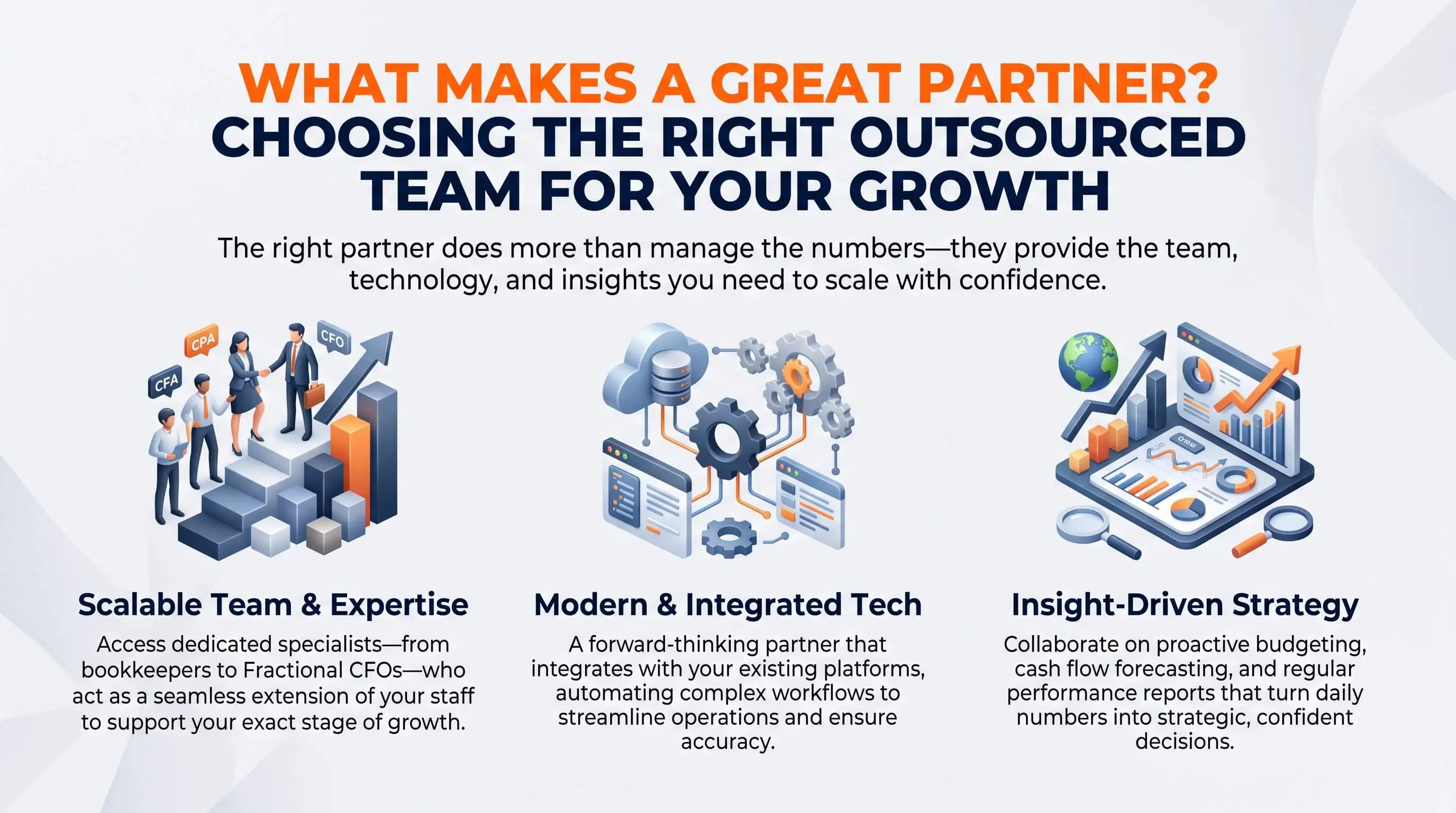
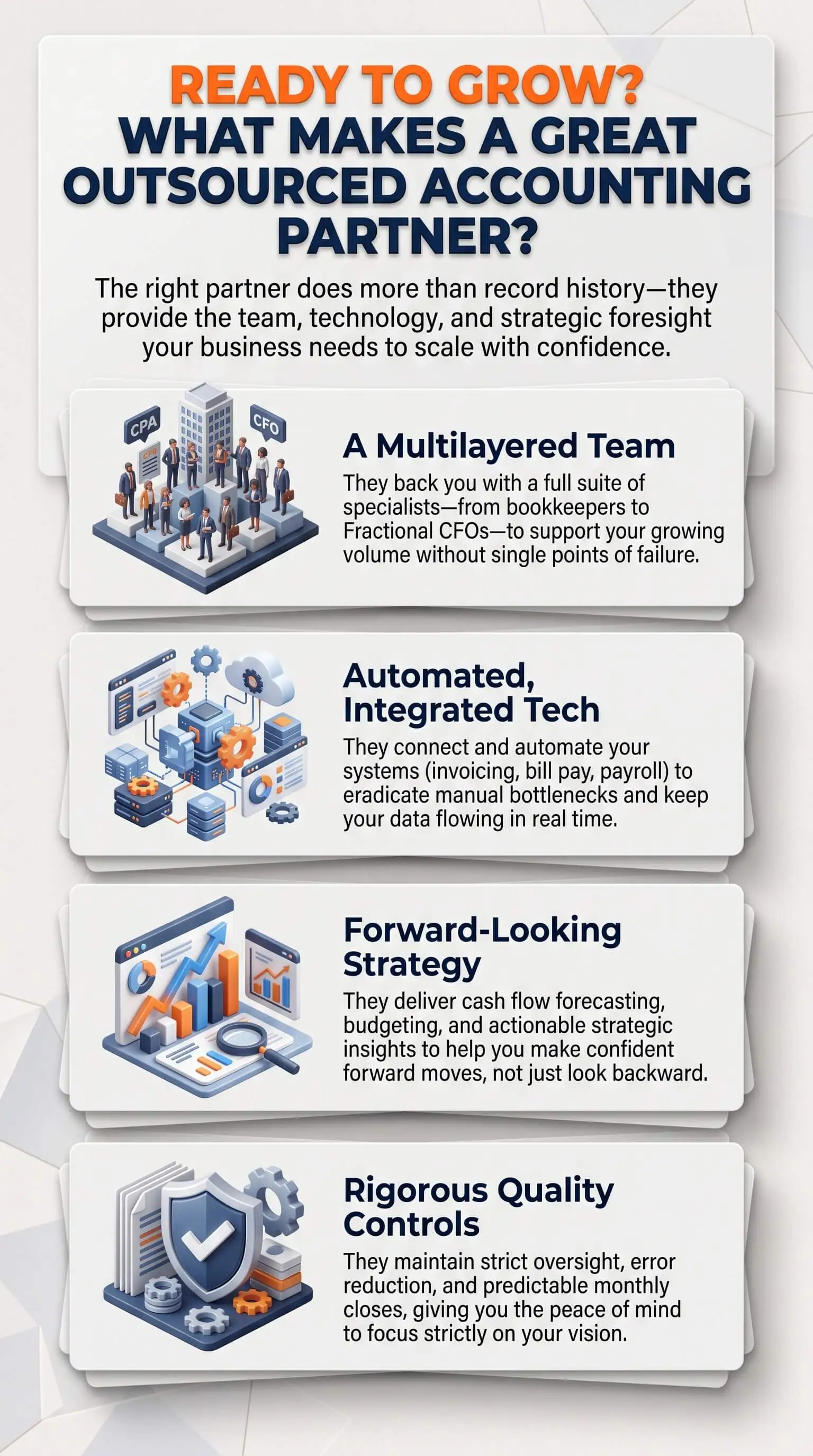
The best outsourced business and financial accounting firms earn that label by delivering reviewed numbers on time and a clear path from bookkeeping to CFO strategy, rather than by being the biggest or cheapest option. Look for these six traits:
Credentialed review: A CPA or senior accountant checks your books every month.
A written close calendar: Your statements arrive on a set date each month.
Services that grow with you: Bookkeeping, outsourced accounting, and fractional CFO support all come from one firm.
Reports you can act on: A balance sheet, cash flow statement, KPIs, and a cash forecast, explained in plain language.
Technology that fits: Secure cloud tools connect to the systems you already use.
Flat, scoped pricing: A written scope comes with full ownership of your data.
Choose the process and fit first, then compare price.
Top Takeaways
Choose a firm that can grow with you from bookkeeping to CFO support.
Make sure a CPA or senior accountant reviews your books every month.
Favor firms that already work with businesses like yours.
Get the month-end close calendar in writing.
Keep the tools that work for you, and require individual, secure logins.
Expect reports you can act on, with someone to explain them.
Insist on flat, scoped pricing and ownership of your data.
What to Look For in an Outsourced Accounting Partner
Your accounting function records every transaction and turns the results into financial statements. An outsourced partner handles some or all of that work from outside the company, usually at one of three levels:
Bookkeeping: recording transactions, reconciling accounts, and keeping payables and receivables current
Outsourced accounting: controller-level oversight, a formal month-end close, and accurate financial statements
Fractional CFO: budgeting, forecasting, and strategy without an executive salary on the payroll
A vendor processes transactions, while a partner tells you what those transactions mean for your next decision. Still deciding whether to outsource at all? Our look at the benefits of outsourced accounting for education professionals makes that case. The traits below are for owners who've decided and want to choose well.
1. A Partner That Grows With You
One firm that covers bookkeeping, controller oversight, and CFO-level planning spares you a painful switch later. Every new provider means re-explaining how your business runs and paying someone to clean up the last firm's files.
Ask what your support would look like if revenue doubled next year.
2. Credentialed People and Clear Review
The person entering your transactions shouldn't be the only one who ever sees them. Strong firms assign a CPA or senior accountant to review each client file every month. You can check any CPA's license on CPAverify before you sign.
On the intro call, find out who reviews your books and what credentials they hold.
3. Experience With Businesses Like Yours
A firm that already knows your industry won't need you to teach it the basics. Nonprofits need fund accounting and grant reporting their boards can follow. A tutoring company or education consultancy needs someone who knows how to book tuition and program fees paid in advance.
Ask how many clients like you the firm supports today.
4. A Close Process You Can See
Request the month-end calendar in writing. It should show which accounts get reconciled, who signs off, and when your statements arrive. For most growing businesses, statements within 15 business days of month-end is a fair expectation [VERIFY], and sooner is better.
Then ask what the firm does when it misses that date.
5. Technology That Fits How You Already Work
Look for a partner that connects cloud accounting software to your bank, payroll, and bill-pay tools and requires multi-factor authentication on every login. Its software vendors should be able to share a SOC 2 report. A firm that wants to tear out your whole setup without a clear reason is showing you a warning sign.
Ask which of your current tools stay and which ones change.
6. Reporting You Can Act On
A profit and loss statement alone can't tell you whether you can afford your next hire. The monthly package should add a balance sheet, a cash flow statement, key performance indicators, and a short-term cash forecast. Just as important, someone should walk you through it in plain language. For a lean example, see what a small nonprofit should see in monthly financial reports.
Before you sign, request a sample monthly package.
7. Transparent Pricing and Clear Data Ownership
A flat monthly fee tied to a written scope is far easier to budget than open-ended hourly billing. Your agreement should spell out what triggers a price change and confirm that the files and account logins belong to you.
Get a clear answer on how and when you'd receive your records if you ever parted ways.
How the Options Compare
Outsourced partner: For a monthly fee, you get a team whose skills run from bookkeeping to CFO strategy, with review built in. Vacations and turnover become the firm's problem, and adding services doesn't mean adding headcount. The trade-off is that your accountant isn't down the hall.
In-house hire: You pay salary, benefits, and training for one person's experience. That makes sense once you need someone on site every day or your volume justifies a dedicated department. Until then, you're buying a narrow skill set with no backup.
Freelance bookkeeper: Often the least expensive choice and perfectly fine for early-stage books. Most freelancers stick to transactions, rarely have anyone reviewing their work, and leave a gap when they move on.
Red Flags to Watch For
No named reviewer or senior accountant assigned to your account
A scope with no written deliverables or deadlines
One shared login instead of individual, permission-based access
Contract terms that make your data hard to retrieve
Hesitation when you ask for references from businesses your size
"The reason growing businesses leave an accounting firm usually isn't bad numbers — it's late ones. A clean March close that shows up in May won't help you decide whether to hire in April.
When I help an owner compare firms, I skip the pitch deck and ask for a redacted month-end checklist and a sample reporting package. The checklist shows me whether a process exists, and the package shows whether anyone plans to turn the numbers into advice.
Owners also tend to judge a firm on price during the first call and on responsiveness by month three. So ask about response times and who your day-to-day contact will be before you compare fees. That one conversation predicts the relationship better than anything in the proposal."
7 Essential Resources
SBA: Manage Your Business: The Small Business Administration's plain-language guide to bookkeeping, accounting methods, and when to bring in a CPA or bookkeeper.
IRS: Recordkeeping for Businesses: The records the IRS expects you to keep, which sets the floor for any partner's bookkeeping.
IRS: How Long Should I Keep Records?: Retention periods worth writing into your contract, including four years for employment tax records.
NASBA: CPAverify: A free national database for confirming that a CPA or firm holds an active license in good standing.
Financial Accounting Standards Board: The body that maintains U.S. GAAP, the reporting standard many lenders and investors expect to see.
SBA Office of Advocacy: Frequently Asked Questions About Small Business 2026: Current federal data on small business employment and paperwork costs.
The Benefits of Outsourced Accounting Services for Education Professionals: Our companion piece on why schools, tutors, and consultants hand off their finances.
An affordable outsourced accounting firm for nonprofits should follow trusted guidance on bookkeeping, recordkeeping, CPA verification, financial reporting standards, and document retention to support accurate and compliant financial management.
3 Statistics
Most businesses are small, so you have options. The SBA Office of Advocacy counts 36.2 million small businesses in the U.S., employing 45.9% of private-sector workers. Plenty of outsourced accounting firms build their services around companies your size, which gives you room to be selective.
Paperwork is expensive, and the IRS drives most of it. Federal paperwork cost small businesses more than $81 billion in 2025, and the IRS accounted for over 80% of that burden, according to the SBA Office of Advocacy's 2026 report. A partner with a documented close process takes much of that work off your plate.
Accounting talent is in demand. The Bureau of Labor Statistics projects about 124,200 openings for accountants and auditors every year through 2034, with a median wage of $81,680 in May 2024. One full-time hire costs more than the salary, and you still end up with a single person's skill set.
Final Thoughts and Opinion
Choose the process first and the price second. In my experience, a firm with a written close calendar, a named reviewer, and a reporting package you understand will save you more than any discount on the monthly fee.
Outsourcing does come with a trade-off worth admitting. You add a handoff, and the arrangement only works if you stay involved. Answer questions quickly, show up for the monthly review, and bring your accountant in before big decisions rather than after. The owners who get the most from it treat their accounting partner as part of the leadership team.
Done well, the move is from reactive to structured. Your numbers show up on time and make sense, and planning finally replaces guesswork.
Frequently Asked Questions
How much does outsourced accounting cost for a small business?
Pricing depends on your transaction volume, how many bank and credit accounts you have, how complex payroll is, and whether you need CFO-level help. Most firms quote a flat monthly fee after reviewing your books. Ask each one for a written scope so you're comparing the same work.
When should a growing business outsource its accounting?
Watch for closes that drag past three weeks, a lender or investor asking for statements you can't produce quickly, payroll or sales tax in more than one state, and an owner doing bookkeeping at night. If two of those sound familiar, start talking with firms.
Is outsourced accounting better than hiring an in-house accountant?
For many growing businesses, yes. You get a team with layered review and a wider skill set without carrying a full-time salary and benefits. An in-house accountant starts to make sense when you need someone on site every day or your volume calls for a dedicated department.
What is the difference between a bookkeeper, an accountant, and a fractional CFO?
A bookkeeper records and reconciles transactions. An accountant, often working at controller level, reviews that work, closes the books, and produces financial statements. A fractional CFO takes those statements and builds budgets, forecasts, and strategy from them. Most growing businesses need each one at a different stage.
Is it safe to give an outsourced accounting firm access to my financial accounts?
It can be, as long as the firm follows sound controls. Look for individual logins instead of a shared password, multi-factor authentication, role-based permissions, and software vendors that can provide SOC 2 reports. You should always be able to see who has access and shut it off.
Can I switch outsourced accounting firms without losing my records?
Yes, provided your agreement says you own your data and account logins. Ask about offboarding before you sign, including how quickly the firm returns files. If you keep the accounting software subscription in your company's name, any future move gets much easier.
Find the Partner That Fits Your Next Stage
A short list and the right questions will get you further than weeks of browsing firm websites.
Write down the accounting tasks that cost you the most time or stress right now.
Decide which level of support you need today: bookkeeping, outsourced accounting, or CFO guidance.
Shortlist three firms that serve businesses your size and industry.
Book a short intro call with each and ask the seven questions from this guide.
Lay the answers side by side and pick the firm that gives you the clearest view of your business. If affordable outsourced accounting services for small firms are part of that decision, leave a comment below, and pass this along to a fellow owner who's outgrowing their spreadsheet.