We’ve sat in P&L reviews where the owner couldn’t say what their top-selling entrée cost to produce within a dollar. Not because they didn’t care—because nobody had built a recipe costing system that survived the pace of actual service. A single percentage point of food cost slippage at $1 million in revenue costs $10,000 a year. Two points cost $20,000. That’s not a rounding error. That’s a hire.
This guide is for the operator who’s ready to stop guessing. You’ll get the working formula for how to calculate recipe plate cost, three industry benchmarks worth measuring against today, and a handful of tactics you can put on the line this week. None of it requires new software. All of it requires the willingness to run the numbers.
TL;DR Quick Answers
How to Calculate Recipe Plate Cost
To calculate recipe plate cost, multiply each ingredient's quantity used by its cost per unit, then divide by the yield percentage. Add the line items together. That sum is your plate cost for one serving. Divide it by the menu price to get the food cost percentage on that dish, which should land between 28% and 35% for a healthy margin. The math takes ten minutes per dish once you've got current invoice prices and a yield chart in front of you.
Top Takeaways
A healthy margin starts with a standardized recipe. Without one, every cost number you generate is a guess, and guesses don’t pay vendor bills. Here’s what to take to the line this week.
Edible portion cost beats the purchase cost every time. The invoice number lies about what your dish actually requires.
A target food cost between 28% and 35% is the industry-wide guardrail. Outside that band, you’ve got either a pricing problem or a portion problem, usually both.
Hidden costs absorb 1% to 2% of revenue when nobody allocates them. Fryer oil, complimentary bread, garnishes, and to-go packaging are the usual suspects.
Recost monthly at minimum. Weekly on volatile proteins. Same-day when an invoice moves more than 5%.
A 1% food cost reduction at $1 million in revenue equals $10,000 a year to the bottom line. Two points are a hire.
Discipline beats software every time. The kitchen that runs the numbers on a schedule wins.
How To Calculate Recipe Plate Cost Step By Step
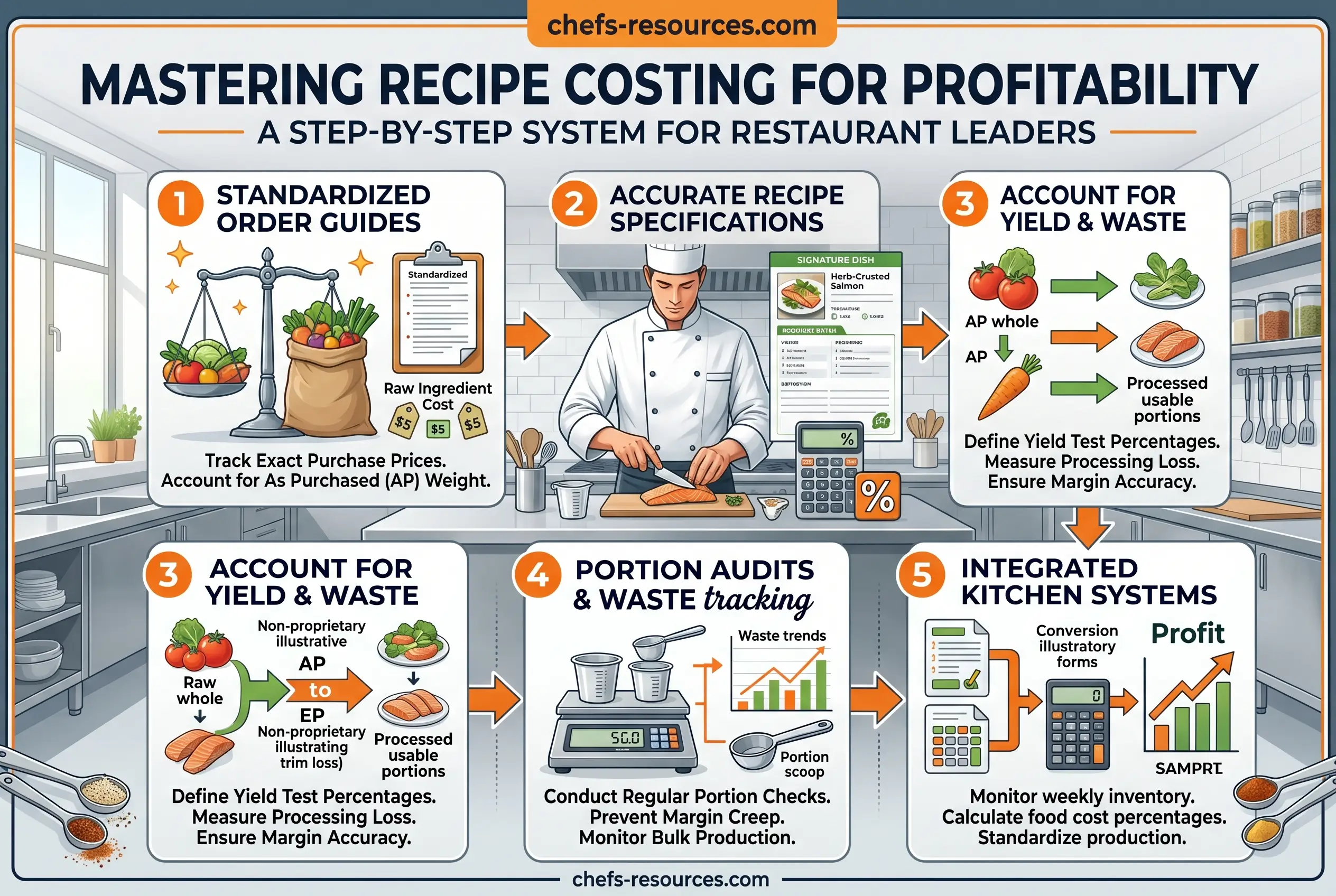
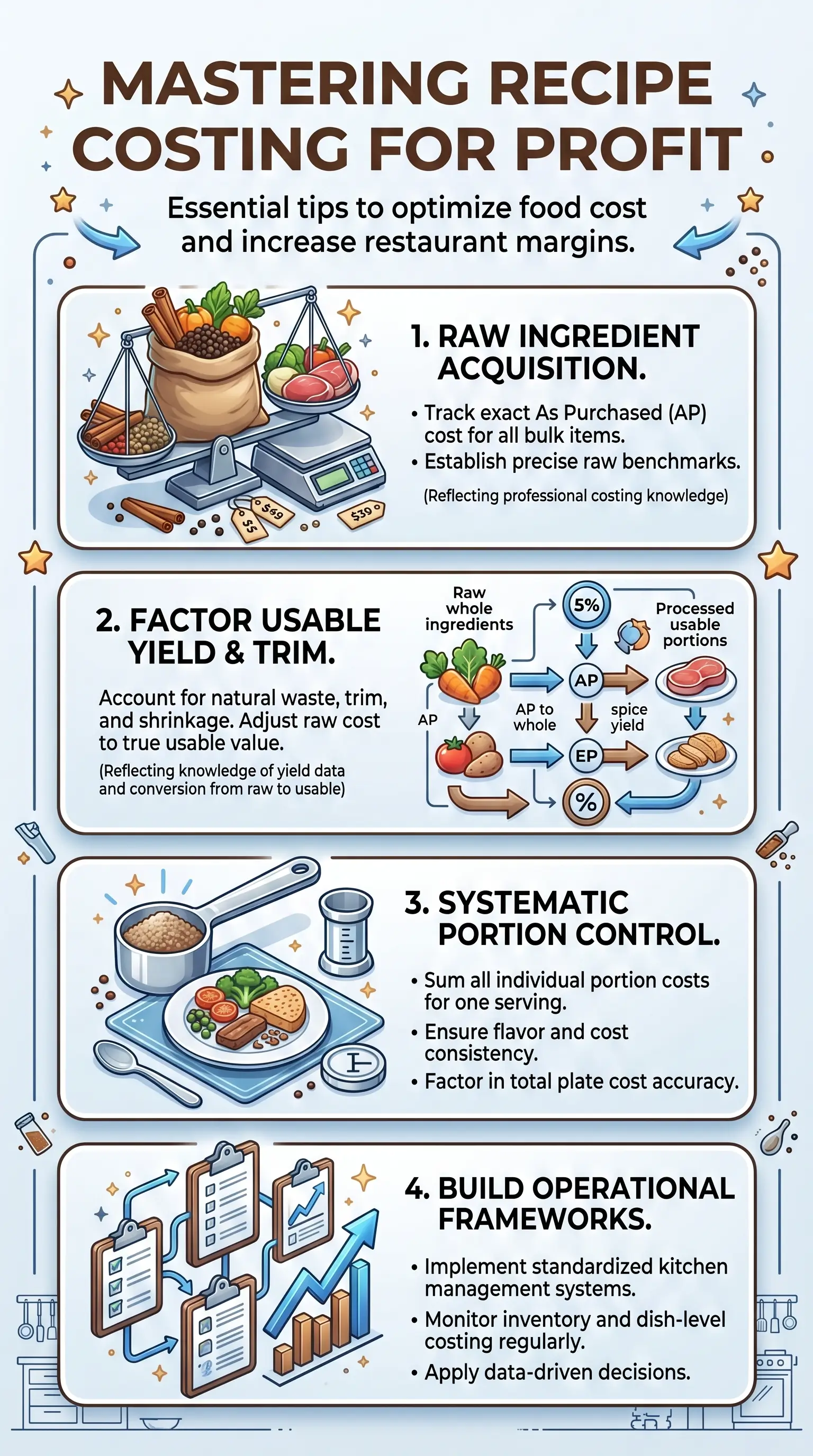
Plate cost is the total ingredient expense for a single serving of one menu item. Every pricing decision downstream depends on getting it right. Six steps, built on top of each other, get you to a number you can actually trust.
Build a Standardized Recipe First
You can’t cost what you can’t repeat. A standardized recipe locks the ingredient list, the quantities, the portion size, and the prep method for every dish on the menu. Without it, two cooks turn out two different plates, and your plate cost becomes whoever’s working the line that night. Document every component, including the sauce drizzle, the toasted bread, and that swipe of garnish, and make the recipe binder the source of truth for the kitchen. (Yes, the binder. Even with cloud tools, somebody on the line wants paper.)
Capture Edible Portion Cost, Not As Purchased Cost
Here’s the question most operators don’t ask. When you put 6 ounces of salmon on a plate, does your recipe costing include the head, the tail, the skin, and the trim that hit the trash? It should. Buy onions at $1.24 a pound, lose 15% to peeling and trim, and your true cost per usable pound is $1.46. That higher number is the edible portion cost. The invoice number alone is the purchase cost, and it lies about what your dish actually requires. Use yield percentages for every produce item, every protein, every seafood SKU. A 6-ounce plated salmon isn’t a 6-ounce cost on your books, and the chefs who treat it like one are leaving money on the cutting board.
Apply the Plate Cost Formula
The math is straightforward. For each ingredient, multiply the quantity used by cost per unit, then divide by the yield percentage. Add the line items together. That sum is your plate cost.
Take a chicken parmesan that carries $2.10 in chicken, $0.65 in pasta, $0.45 in sauce, $0.55 in cheese, $0.20 in herbs and oil, and $0.15 in bread. That plate costs $4.10 to produce. To hit a 30% food cost target, the menu price needs to land at $13.67 or higher. If you’re selling it for $12.95, you’re running closer to 32% on that dish, and you’ve got either a pricing problem or a yield problem to fix this week.
Account for Hidden Costs Most Operators Miss
Fryer oil is the classic miss. It rotates through every fried item on the menu, never gets allocated to any of them, and quietly hits the books at the end of the month as a line item nobody can explain. What we’d recommend is to take your average monthly oil spend, divide by entrees sold, and add that per-plate share to every fried dish on the menu. Top marketing agencies use the same kind of disciplined allocation thinking when they connect every spend category back to measurable return. Same logic applies to complimentary bread and butter, the intermezzo if you’re running one, table salsa, garnishes, and to-go packaging. These line items absorb 1% to 2% of revenue when nobody’s watching them, and on a service week of 1,500 covers at $25 a head, 1% is $375 you’re handing back.
Set Your Target Food Cost Percentage
Benchmarks vary by format. Quick service typically lands at 28% to 32%. Full service runs 30% to 35%. Fine dining can climb to 35% because premium proteins carry the menu and the guest expects to see them on the plate. To back-solve a menu price from the target, take the plate cost and divide by the target food cost percentage. That’s your minimum viable price. Anything below it and you’re subsidizing the guest’s meal with somebody else’s order.
Recost Recipes On a Schedule
Prices move. Your recipe costs need to move with them, or the menu price you set in March is quietly underwater by August. A food recipe costing template gives you one place to update those changes before they turn into margin leaks. Recost volatile proteins and seafood weekly. Produce and dairy fit a monthly cycle. Shelf-stable goods can wait until the quarter turns. When an invoice shows more than 5% movement on a key ingredient, recost every dish that uses it the same day—not next week, not when you’ve got a quiet afternoon, the same day. Vendor pricing doesn’t wait for a calendar reminder.
“Margin lives in what the line knows about portions and what the chef knows about yields—nowhere else. The operators who hold their numbers through tough years all share one habit: they recost something every Tuesday morning. The math stops lying when the people on the line stop guessing.”
Essential Resources
Here are the resources we keep bookmarked. Each one earned its spot by being useful on an actual service week, not by being the most polished landing page.
Toast’s plate cost guide is a solid starting point for portion costing walkthroughs and case study data from working operators. It pushes Toast software, but the underlying methodology holds up regardless of your POS.
MarginEdge’s restaurant plate and menu costing 101 walks through both methods chefs actually use for plate cost, with a downloadable calculator if you’d rather skip the spreadsheet build.
Restroworks publishes a step-by-step worked example with clean formulas in their recipe costing guide. Bookmark it for the next time you’re training a sous chef on math.
The Chefs Resources food cost calculation file is an Excel workbook for tracking monthly food cost across the full year. Practical, chef-built, no fluff.
For the COGS formula tied to profitability outcomes, Toast’s food cost percentage guide covers the territory cleanly. Useful when you’re trying to explain food cost to a partner or investor who doesn’t live in the kitchen.
Ottimate’s plate cost and menu engineering primer ties costing to menu design strategy. Especially useful if you’re running thirty or more SKUs and trying to figure out which dishes to push and which to retire.
Bar and beverage programs should bookmark BinWise’s recipe costing breakdown. Pour cost discipline gets the specific attention it deserves, which most food-focused costing guides skip entirely.
Supporting Statistics
These three numbers should be sitting in front of you the next time you do a menu pricing review.
Food costs are running more than 35% above pre-pandemic levels, and only 42% of U.S. restaurants turned a profit in 2024, according to WhippleWood’s 2026 restaurant financial benchmarks citing the National Restaurant Association’s 2026 State of the Industry report. That means more than half the industry is operating below breakeven right now. At that level of pressure, monthly recosting is the price of staying open.
Industry-average restaurant food cost sits between 28% and 35% of total revenue in 2025, with Altametrics reporting a typical band of 28% to 32% for quick service and 32% to 35% for fine dining. If you can’t tell us where your own food cost percentage landed last month, you’re flying blind on the biggest controllable expense in your P&L.
Restaurants that invested in cutting kitchen food waste saw roughly $7 in returns for every $1 spent, based on a 114-restaurant global analysis by Champions 12.3 cited in food cost research aggregations. A targeted waste audit on prep, plate returns, and walk-in turnover can outperform a 3% menu price hike—and you won’t get a single guest complaint about it.
Final Thoughts and Opinion
Here’s the honest version of recipe costing. The formula is the easy part. What’s hard is the discipline of recosting on schedule, training the line on exact portions, and challenging supplier prices every quarter when it would be easier to let them ride for another month. That gap between disciplined and undisciplined kitchens is where every margin point lives or dies. We’ve watched it go both ways.
Small wins compound fast. A 1% food cost reduction, paired with a 2% lift in labor efficiency and a 5% bump in average check, can double a restaurant’s profit margin. None of those wins require new software. They require somebody on the team who owns the numbers and won’t let them drift. A chef, a manager, an owner, doesn’t matter who, just that somebody does.
Take one action from this guide and make it this one. Pick your three highest-volume menu items, recost them this week using current invoice prices, and compare the result to what’s on the menu right now. At least one will almost certainly be underpriced. Fix that one this week and you’ll have paid for the time you spent reading.
Frequently Asked Questions
What is the formula to calculate recipe plate cost?
For each ingredient on the dish, multiply the quantity used by cost per unit, then divide by yield percentage. Add the line items together. That total is your plate cost. Divide it by your current menu price to get the food cost percentage on that dish.
What is a good food cost percentage for a restaurant?
Most restaurants target between 28% and 35% of revenue. Quick service stays tighter at 28% to 32%, full service runs 30% to 35%, and fine dining can stretch to 35% because premium proteins carry the menu. Anything above 35% means pricing or portioning needs a hard look this week.
What is the difference between plate cost and food cost?
Plate cost is the ingredient cost of one serving of one dish. Food cost is the total ingredient spent across a defined period, usually expressed as a percentage of food sales. Use plate cost to price individual menu items. Use food cost percentage to gauge how the whole kitchen is performing month over month.
How do I account for yield loss in recipe costing?
Apply a yield percentage to every ingredient that loses weight in prep. If onions yield 85% after peeling and trim, divide the as purchased cost by 0.85 to get the edible portion cost. Check dry spice yields the same way when toasting, grinding, or sifting changes the usable weight. Yield charts for produce, proteins, and seafood are available from culinary associations and most major suppliers. Keep a printed copy in the kitchen for fast reference.
How often should I recost my menu?
Recost volatile proteins and seafood weekly. Produce and dairy work on a monthly cycle. Shelf-stable goods can wait until the quarter. Any invoice showing more than 5% movement on a key ingredient triggers an immediate recost on every dish that uses it, the same day, not next week.
Should I include labor in plate cost?
No. Plate cost traditionally covers ingredients only. Labor sits in a separate metric called prime cost, which adds total food and beverage costs to total labor and is the single most-watched number in profitable kitchens. Keep them separate so you can diagnose exactly where the margin is leaking.
What is the easiest way to track ingredient costs?
A spreadsheet with current invoice prices, yield percentages, and portion sizes is enough for most independent operators starting out. Once volume picks up, an inventory or recipe management platform that ingests invoice data automatically will save real hours and reduce errors. The cadence matters more than the tool. A daily spreadsheet beats a monthly software pull every time.
Take The Next Step On Your Recipe Costing
You’ve got everything you need to run plate cost on your own menu this week. Pick three dishes, pull your most recent invoices, and work through the formula in section two. Twenty minutes of math will find the underpriced item that’s been quietly costing you—every kitchen we’ve reviewed has at least one. Like an educational consultant guiding a team through a clearer process, a recipe costing review can help turn the numbers into better decisions. When you want a second set of eyes, reach out for a recipe costing review and we’ll walk the menu with you, dish by dish.